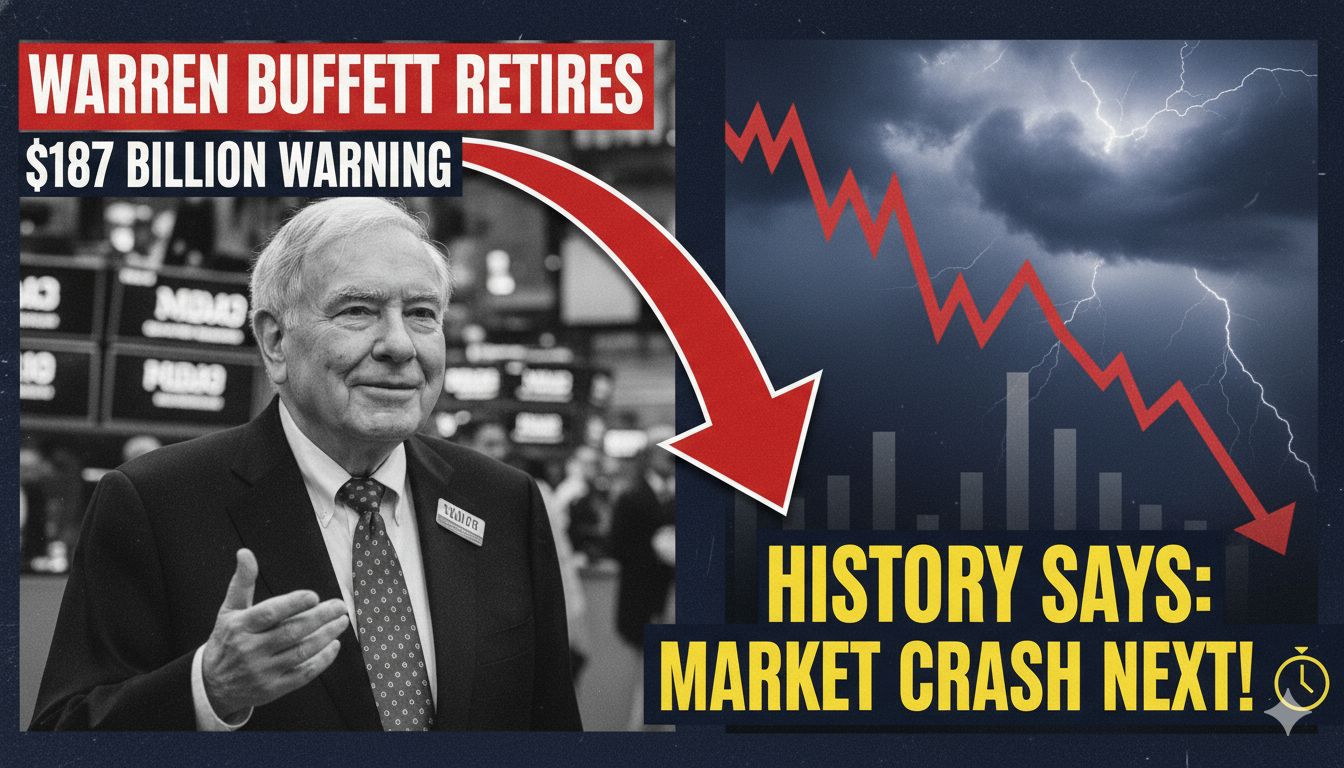
“As Warren Buffett steps away from the CEO role at Berkshire Hathaway after six decades, his final act as leader speaks volumes: a staggering $187 billion in net stock sales over 13 consecutive quarters. This massive shift to cash signals deep caution amid elevated valuations, echoing historical patterns where such restraint from value investors preceded significant market pullbacks or corrections.”
The Oracle’s Silent Exit and the Cash Fortress
Warren Buffett officially stepped down as CEO of Berkshire Hathaway on January 1, 2026, handing the reins to longtime deputy Greg Abel while remaining chairman of the board. At 95, the transition marks the end of an era for the conglomerate that Buffett transformed from a struggling textile company into a $1 trillion powerhouse. Yet his departure comes not with fanfare but with a clear, unspoken message delivered through Berkshire’s actions: the stock market appears overpriced, and patience is paramount.
In the period leading up to and including his final months at the helm, Buffett and portfolio manager Ted Weschler maintained a disciplined net-selling stance. Over the last 13 quarters, Berkshire executed net sales of stocks totaling $187 billion. This marked a sharp reversal from Buffett’s earlier comments, such as in 2018 when he noted it was rare for Berkshire not to be a net buyer of equities. The prolonged selling streak reflects a scarcity of opportunities that meet his stringent criteria—businesses with durable competitive advantages trading at reasonable prices.
This caution has manifested in Berkshire’s balance sheet as an enormous cash position. As of December 31, 2025, cash and U.S. Treasury holdings stood at $373.3 billion, down slightly from the third-quarter peak of $381.7 billion but still representing one of the largest liquid reserves ever held by a single company. New CEO Greg Abel, in his first annual shareholder letter, described this hoard as “strategic dry powder” rather than a retreat from investing. He emphasized Berkshire’s commitment to deploying capital into productive businesses over holding Treasuries long-term, while preserving the company’s fortress-like balance sheet.
The scale of this cash buildup is telling. Berkshire’s insurance float—premiums collected upfront to cover future claims—continues to provide low-cost leverage, standing at around $176 billion. Combined with operating cash flows that averaged over $40 billion annually in recent years, the company has ample resources. Yet Buffett’s team has chosen to sit on the sidelines for equities, opting instead to accumulate short-term government securities yielding modest but safe returns.
Why the $187 Billion Sell-Off Matters
Buffett’s approach has always prioritized intrinsic value over market momentum. When valuations stretch, he has historically pulled back, as seen in periods before major downturns. The current environment shows similarities: high price-to-earnings multiples across broad indices, driven by enthusiasm in technology and growth sectors. Berkshire’s concentrated equity portfolio—historically heavy in names like Apple, which saw continued trimming—further underscores selectivity.
In recent quarters, sales included significant reductions in Apple and Bank of America holdings, alongside other adjustments. These moves boosted liquidity without aggressive buying elsewhere. Abel’s letter reinforced continuity: disciplined capital allocation, focus on understandable businesses with strong management, and avoidance of overpaying. He noted disappointing outcomes in certain investments, such as Kraft Heinz, but stressed long-term orientation.
Historically, extended periods of net selling by value-oriented giants like Buffett have preceded market adjustments. When investors broadly chase returns in richly priced assets, corrections often follow as reality sets in—whether through economic slowdowns, interest rate shifts, or sentiment changes. The so-called Buffett Indicator (total U.S. stock market capitalization relative to GDP) has hovered at elevated levels, approaching or exceeding historical peaks that signaled caution in the past.
What History Suggests Comes Next
Markets rarely move in straight lines, but patterns emerge. Periods of extreme caution from disciplined investors have often aligned with subsequent volatility or declines. For instance, when valuations detach from fundamentals, mean reversion tends to occur—sometimes sharply.
The current setup points to potential underperformance or a meaningful pullback in the coming years. Elevated multiples leave little margin for error if earnings growth disappoints or external pressures mount, such as policy shifts or geopolitical events. Buffett’s $187 billion in sales isn’t a prediction of imminent crash but a vote of no confidence in prevailing prices. History indicates that when the “smart money” builds cash rather than deploys it aggressively, broader markets often face headwinds before attractive opportunities reemerge.
Investors should consider this backdrop carefully. Maintaining exposure to high-quality holdings with reasonable valuations remains sound, but over-allocating to momentum-driven names carries risks. Cash reserves provide optionality, allowing deployment when bargains appear—as Buffett has done repeatedly over decades.
Looking Ahead Under New Leadership
Greg Abel inherits a remarkably strong platform: diverse operating businesses generating consistent cash, a massive liquidity buffer, and a culture of prudence. His early statements suggest no radical shifts—Berkshire will prioritize resilience, opportunistic acquisitions, and share repurchases when undervalued. The cash pile offers flexibility for large-scale moves if markets correct.
Buffett’s retirement closes one chapter but underscores timeless principles: invest with a margin of safety, be fearful when others are greedy, and patient when opportunities are scarce. The $187 billion warning endures as a reminder that even legends avoid overpaying.
Disclaimer: This is for informational purposes only and does not constitute investment advice, financial recommendations, or endorsements of any security or strategy.