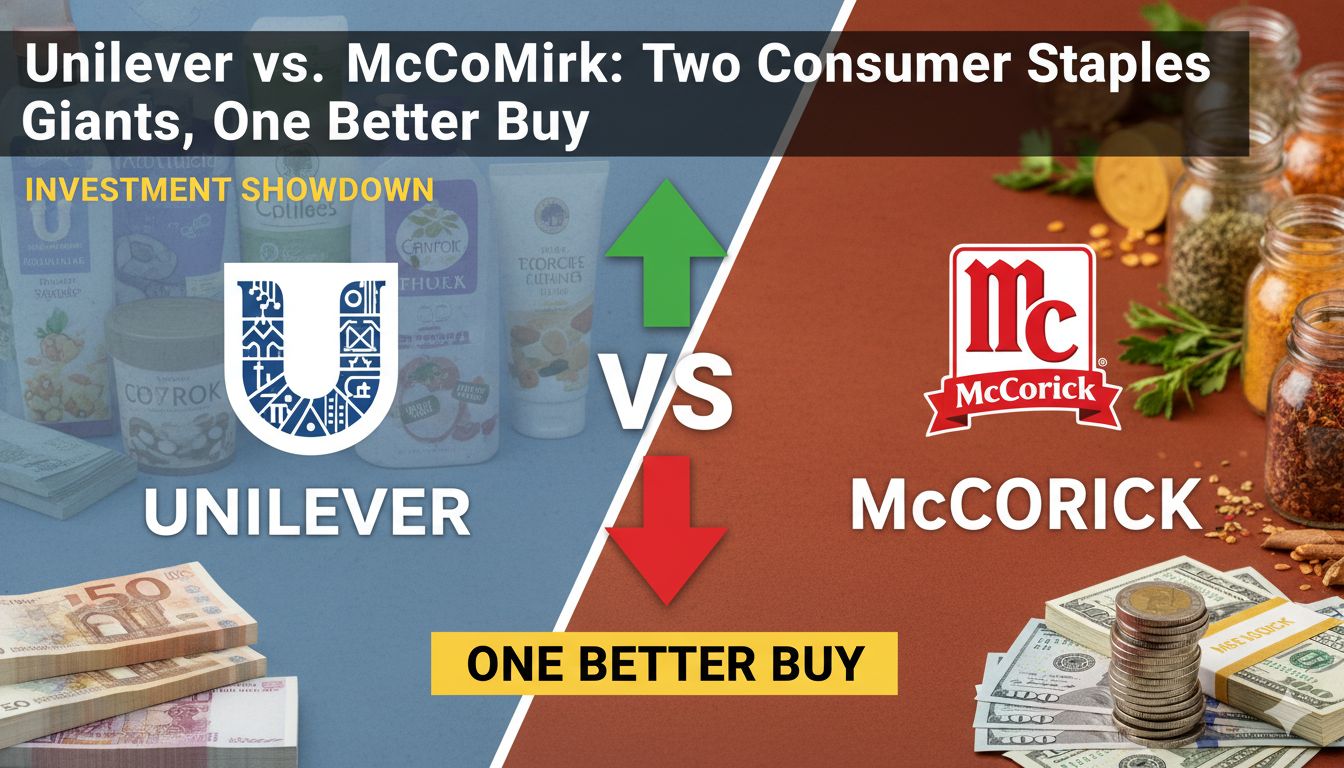
“Unilever delivers broader global diversification and stronger recent margin expansion amid portfolio reshaping, while McCormick faces valuation pressures and softer near-term guidance despite its Dividend Aristocrat status and flavor market leadership—tilting the scales toward Unilever as the superior long-term investment in the current environment.”
In the resilient world of consumer staples, Unilever and McCormick stand out as established players with defensive qualities that appeal to investors seeking stability through economic cycles. Unilever, a multinational powerhouse, spans beauty, personal care, home care, and nutrition products with iconic brands like Dove, Hellmann’s, Knorr, and Lipton. McCormick focuses more narrowly on the flavor segment, leading in spices, seasonings, condiments, and extracts under its namesake brand and others like French’s and Old Bay.
Both companies benefit from essential everyday demand—personal hygiene and flavor enhancement remain non-negotiable for households—but their scale, geographic reach, and recent performance reveal meaningful differences for investors.
Unilever operates on a vastly larger scale. Its 2025 turnover reached €50.5 billion (approximately $54-55 billion USD equivalent, adjusted for currency), even after accounting for portfolio changes including the Ice Cream demerger. This reflects a diversified portfolio where Power Brands (78% of turnover) drove 4.3% underlying sales growth and 2.2% volume growth. The company achieved 3.5% underlying sales growth for the full year, accelerating to 4.2% in the fourth quarter with 2.1% volume contribution. Gross margins improved to 46.9%, up 20 basis points, enabling underlying operating margin expansion to 20.0%, a 60 basis point increase driven by productivity savings and overhead discipline. Underlying earnings per share rose modestly to €3.08, while free cash flow hit €5.9 billion with full cash conversion. The company returned significant capital through dividends and buybacks, announcing a new €1.5 billion program.
McCormick, by contrast, reported fiscal 2025 net sales of $6.84 billion, a 1.7% increase year-over-year on a reported basis (1.9% constant currency). Adjusted operating income grew 2.3%, with margins expanding slightly to around 16.0%. Adjusted earnings per share rose 1.7% to $3.00. The company maintained strong cash flow from operations at $962 million and increased its dividend for the 40th consecutive year. However, challenges included input cost inflation, competitive pressures from private labels, and softer consumer demand in certain segments.
Key Financial Comparison (Latest Full-Year Data)
| Metric | Unilever (2025) | McCormick (Fiscal 2025) |
|---|---|---|
| Revenue/Turnover | €50.5 billion (~$54-55B USD) | $6.84 billion |
| Underlying/Organic Sales Growth | 3.5% (1.5% volume) | ~1-2% organic (implied) |
| Operating Margin (Underlying/Adjusted) | 20.0% | ~16.0% |
| Gross Margin (Underlying/Adjusted) | 46.9% | ~37.9% |
| EPS (Underlying/Adjusted) | €3.08 | $3.00 |
| Free Cash Flow | €5.9 billion | $962 million |
| Dividend Yield (Approximate, Recent) | ~3.5-3.6% | ~3.1-3.14% |
Unilever’s margin profile stands out as superior, reflecting economies of scale, successful pricing discipline, and structural improvements in gross profitability. Its Foods division achieved a record underlying operating margin of 22.6%, underscoring strength in core categories like sauces and nutrition. McCormick’s narrower focus on flavors provides resilience but exposes it more directly to commodity volatility and private-label competition in spices and seasonings.
Stock performance reflects these dynamics. Unilever (NYSE: UL) trades around $64, near the lower end of its 52-week range of roughly $61-75, with a market cap exceeding $140 billion. This positions it at a forward P/E in the mid-to-high teens, offering reasonable value given its global footprint and growth reacceleration. McCormick (NYSE: MKC) has seen sharper declines, trading near $58 after hitting a 52-week low in the $57 range (from highs above $83), resulting in a market cap around $15-16 billion. Recent softness stems from earnings pressures, tariff concerns, and cautious 2026 guidance projecting modest adjusted EPS growth of 2-5% amid ongoing cost headwinds.
Unilever’s strategic edge includes aggressive portfolio reshaping—completing the Ice Cream separation while acquiring high-growth assets in premium beauty and wellbeing—and a sharper focus on high-margin categories and emerging markets like India and Indonesia. Its outlook calls for 4-6% underlying sales growth in 2026 (with at least 2% volume) and modest margin improvement, signaling confidence in sustained momentum.
McCormick remains a quality compounder with unmatched brand strength in flavors, but elevated valuations historically and recent macro sensitivities (including supply chain risks) limit near-term upside. Its 2026 outlook anticipates 1-3% organic sales growth plus acquisition contributions, with margin recovery targeted but tempered by inflation.
For long-term investors prioritizing defensive growth, diversification, and attractive risk-adjusted returns, Unilever emerges as the better buy . Its larger scale, superior margins, ongoing transformation, and undervalued positioning relative to historical norms provide a more compelling case in today’s uncertain environment, where volume-driven recovery and capital returns stand out.
Disclaimer: This is for informational purposes only and does not constitute investment advice, financial recommendations, or a solicitation to buy or sell securities. Investors should conduct their own research and consult professionals before making decisions.