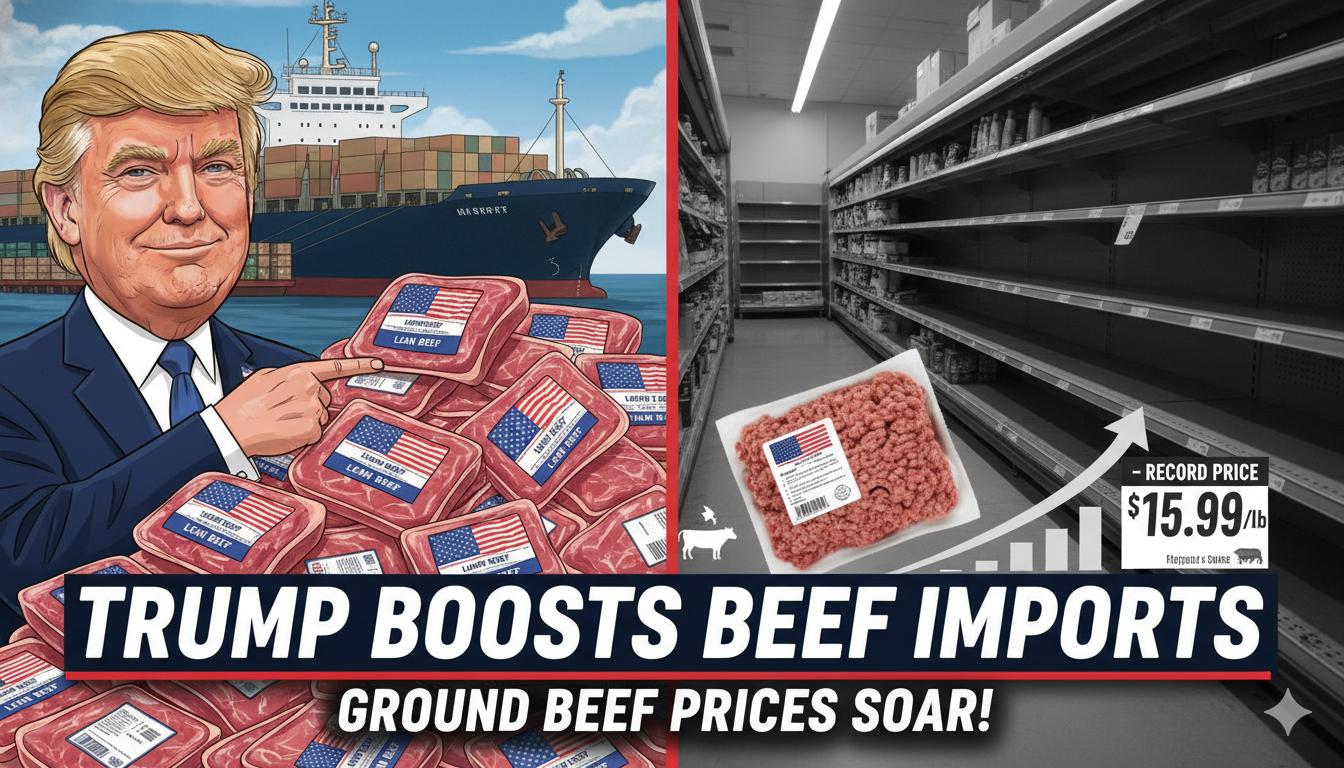
“President Trump has signed a proclamation increasing the U.S. tariff-rate quota for lean beef trimmings by 80,000 metric tons in 2026, allocating the entire boost to Argentina to supplement domestic supplies and ease pressure on ground beef prices, which hit an average of $6.69 per pound in December 2025 amid a U.S. cattle herd contraction to 86.2 million head—the smallest since 1951—with beef cow numbers falling 1% to 27.6 million, signaling persistent supply tightness and elevated retail costs projected to stabilize between $9.00 and $9.50 per pound this year.”
The recent executive action by President Trump targets a critical juncture in the U.S. beef sector, where domestic production constraints have driven ground beef to unprecedented price levels. By temporarily quadrupling the tariff-free import quota for lean beef trimmings from Argentina to 100,000 metric tons total for the year—up from the standard 20,000 metric tons—the administration aims to inject additional supply into the market. This increase will be distributed in four equal quarterly tranches of 20,000 metric tons each, starting with the first opening soon after the proclamation’s signing.
Lean beef trimmings, primarily used in ground beef production, represent a key component blended with domestic fat trimmings to create the hamburger patties and other products that form a staple in American diets. With the U.S. facing a multi-year decline in cattle inventories, this move seeks to bridge the gap between shrinking herds and consumer demand, potentially stabilizing wholesale and retail prices that have surged due to limited availability.
Cattle Herd Dynamics and Supply Challenges
The U.S. cattle inventory has continued its downward trajectory, with the total herd standing at 86.2 million head at the start of the year, marking a slight decline from the previous period and representing the smallest national herd in over seven decades. Beef cows, the backbone of the industry, number 27.6 million head, reflecting a 1% reduction year-over-year. This contraction stems from a combination of factors, including prolonged drought conditions in key ranching states, elevated feed costs, and producers’ decisions to cull herds rather than retain heifers for expansion amid economic uncertainties.
Heifer retention, a critical indicator of future herd growth, has shown only marginal improvement, with all heifers 500 pounds and over totaling 18.0 million head, down 1% from last year. Beef replacement heifers are estimated at 4.8 million head, a modest 1% increase, suggesting that any meaningful rebuild could take years to materialize. The calf crop for the prior year came in at 32.9 million head, the smallest since the early 1940s, further underscoring the tightness in feeder cattle supplies.
Dairy cows, meanwhile, have bucked the trend with a 2% increase to 9.57 million head, driven in part by the rise of beef-on-dairy crossbreeding programs. These initiatives have added approximately 3.22 million head to feeder supplies annually, with projections indicating a potential rise to 5-6 million by year-end. However, this offset has not fully compensated for the broader beef herd shrinkage, leading to reduced slaughter volumes and higher carcass weights as producers hold animals longer to maximize yields.
Cattle on feed inventories have also dipped, totaling 13.8 million head, a 3% decrease, which points to fewer animals entering feedlots and a subsequent drop in beef production. Forecasts indicate a 2% contraction in overall beef output this year, following a 3.5% decline in the previous period, with fed cattle slaughter expected to fall by another 600,000 head after a 1.4 million head reduction last year.
Price Surge in Ground Beef and Retail Impacts
Ground beef prices have escalated to record territory, with the average retail price for 100% beef reaching $6.687 per pound in the final month of last year, up from prior levels and marking the highest since comprehensive tracking began in the 1980s. All-fresh beef prices closed the previous year at $9.55 per pound, reflecting a $1.47 increase year-over-year, while conventional all-fresh beef has climbed to $8.80 per pound and is on track to hit $9.20 per pound.
Projections for the current year suggest fed cattle prices in the early months ranging between $230 and $240 per hundredweight, with the composite cutout averaging near $350 per hundredweight. Retail beef prices are anticipated to hold steady in the $9.00 to $9.50 per pound range, though the first half of the year may see continued upward pressure due to seasonal demand peaks and lingering supply constraints.
Wholesale values for choice cuts stand at $369.91 per hundred pounds, while select cuts are at $363.85 per hundred pounds, illustrating the premium placed on available product. Analysts expect feeder cattle values to remain elevated in the $350-$360 per hundredweight range during the initial quarters, as market participants grapple with limited inventories.
The following table outlines recent trends in key beef price indicators:
| Category | December 2025 Price ($/lb) | Projected 2026 Average ($/lb) | Year-Over-Year Change |
|---|---|---|---|
| Ground Beef (100% Beef) | 6.687 | 6.80 – 7.00 | +2.2% |
| All-Fresh Beef | 9.55 | 9.00 – 9.50 | +1.5% |
| Conventional All-Fresh | 8.80 | 9.20 | +4.5% |
| Choice Cutout | 369.91 (per 100 lbs) | 350.00 (per 100 lbs) | -1.8% |
| Select Cutout | 363.85 (per 100 lbs) | 345.00 (per 100 lbs) | -2.0% |
These figures highlight the persistent elevation in costs, which have ripple effects across the food supply chain, from processors to supermarkets and restaurants.
Import Expansion Details and Market Implications
Under the new proclamation, the additional 80,000 metric tons of lean beef trimmings will be classifiable under specific harmonized tariff schedule codes, ensuring they are directed toward ground beef production. This allocation is exclusive to Argentina, leveraging established trade ties and the country’s reputation for high-quality grass-fed beef. The quarterly tranches are designed to provide steady inflows, helping to mitigate seasonal fluctuations in domestic availability.
This policy adjustment comes amid other supply disruptions, such as restrictions on cattle imports from certain regions due to disease concerns, which have further strained feedlot stocks. By focusing on lean trimmings, the imports complement U.S. production, where domestic cattle often yield higher fat content, allowing for efficient blending to achieve desired lean-to-fat ratios in ground products.
Industry observers anticipate that this influx could add roughly 176 million pounds of lean beef to the market, potentially easing wholesale pressures and providing some relief at the retail level. However, the full impact may not be immediate, as it takes time for imported product to clear customs, enter processing facilities, and reach consumers. Long-term, the measure underscores the need for domestic herd rebuilding, with expectations that the beef cow herd could edge up by about 150,000 head to near 28 million by year’s end, signaling the start of a slow expansion cycle.
Broader Economic Context in Beef Trade
U.S. beef consumption remains robust, projected at around 28 billion pounds annually, though per capita intake has adjusted downward in response to higher prices. Exports continue to play a vital role, with key markets in Asia and Europe absorbing premium cuts, while imports fill niches like lean trimmings that are underrepresented in domestic output.
The administration’s monitoring directive assigns the Secretary of Agriculture, in coordination with the U.S. Trade Representative, to track lean beef supplies and recommend further actions if shortages persist. This proactive stance reflects ongoing efforts to balance producer interests with consumer affordability, particularly as input costs for ranchers—such as hay, corn, and labor—remain elevated.
Key points from the current market landscape include:
Herd Rebuild Timeline: Expansion is unlikely to yield significant supply increases until 2028, given the two-year cycle for raising cattle to market weight.
Crossbreeding Growth: Beef-on-dairy programs are expected to plateau, contributing a stable but not expanding share to feeder supplies.
Price Stabilization Factors: Increased imports and slight heifer retention could cap further escalations, though external variables like weather and global demand will influence outcomes.
Consumer Behavior Shifts: Higher prices have prompted some substitution toward poultry and pork, but beef’s cultural prominence in American cuisine sustains demand.
This interplay of domestic constraints and strategic imports shapes the trajectory for the U.S. beef industry, with the recent policy serving as a bridge to longer-term recovery.
Disclaimer: This news report is based on available sources and tips.