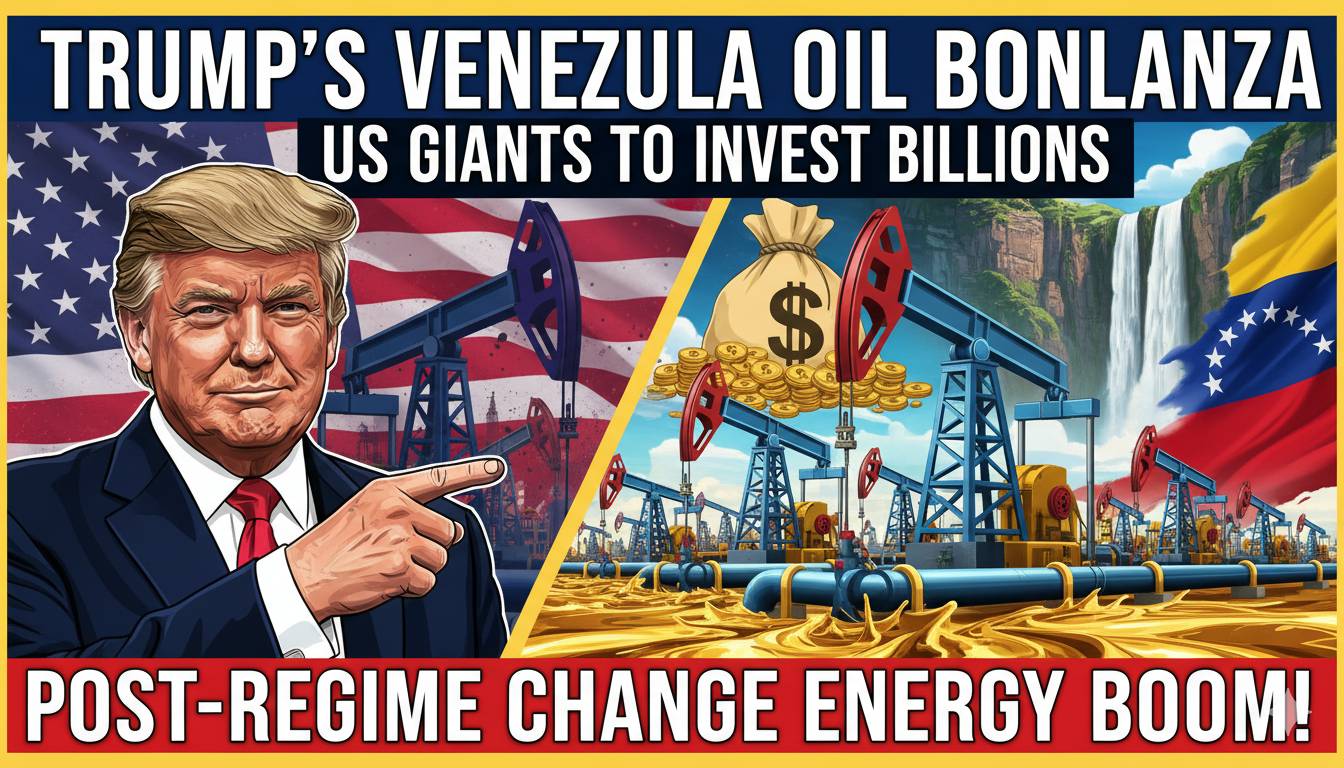
“President Trump has revealed plans for major US oil companies to inject billions into Venezuela’s crumbling energy infrastructure, aiming to revive production from the world’s largest reserves. This move follows a swift regime change, promising economic gains for both nations amid global oil surpluses, though challenges like low prices and security risks loom.”
President Trump’s declaration marks a pivotal shift in US-Venezuela relations, positioning American energy firms at the forefront of revitalizing a sector plagued by decades of neglect. With Venezuela holding an estimated 300 billion barrels of proven oil reserves—surpassing even Saudi Arabia’s—the potential for output expansion is immense. Current production hovers around 1 million barrels per day, a fraction of the 3.5 million barrels per day peak seen in the late 1990s.
US oil giants, including those with historical ties like Chevron and ExxonMobil, stand to benefit from renewed access. Trump emphasized that these companies would “spend billions” to modernize pipelines, refineries, and extraction facilities, many of which haven’t been updated in over 50 years. Analysts project that returning to 2 million barrels per day by the early 2030s could require upwards of $110 billion in total investment, with US firms leading the charge to extract “tremendous wealth.”
This strategy aligns with broader US energy goals, potentially reducing dependence on volatile Middle Eastern supplies and stabilizing domestic fuel costs. Amid a global oil glut, Brent crude prices are lingering below $60 per barrel, which could temper immediate enthusiasm but create long-term opportunities for cost-effective development. Venezuela’s heavy, sour crude is particularly valuable for producing diesel and industrial fuels, complementing lighter US shale outputs.
Key Points:
Reserve Dominance : Venezuela’s 300 billion barrels represent about 18% of global proven reserves, offering a strategic asset for US energy security.
Production Revival : From current lows of roughly 800,000-1.1 million barrels per day, investments could triple output within a decade, adding stability to global markets.
Economic Impact : Revamped operations might generate billions in revenue for Venezuela while creating jobs and supply chain benefits for US firms, potentially lowering diesel prices for American industries.
Challenges Ahead : Low oil prices around $50-60 per barrel, coupled with infrastructure decay and geopolitical uncertainties, may delay full-scale returns. Security for personnel and assets remains a priority, as does navigating legal claims from past nationalizations.
| Aspect | Current Status | Projected Post-Investment |
|---|---|---|
| Oil Reserves | 300 billion barrels | Untapped potential unlocked |
| Daily Production | ~1 million bpd | Up to 2-3 million bpd by 2030s |
| Investment Needed | $58 billion for basics | $110 billion for full scale |
| Crude Price Influence | Minimal (1% global supply) | Could ease global surpluses |
| US Company Role | Limited due to past sanctions | Leading billions in upgrades |
The initiative could reshape hemispheric energy dynamics, diverting flows from current buyers like China and opening doors for Western partnerships. While short-term disruptions from the regime transition might halt some exports, ample global supplies are expected to keep price spikes in check. For US investors, this represents a high-stakes bet on stabilizing a resource-rich neighbor, with ripple effects on stock performances in the energy sector.
Disclaimer: This article is for informational purposes only and does not constitute financial advice, investment recommendations, or endorsements. All data and opinions are derived from general market analyses.