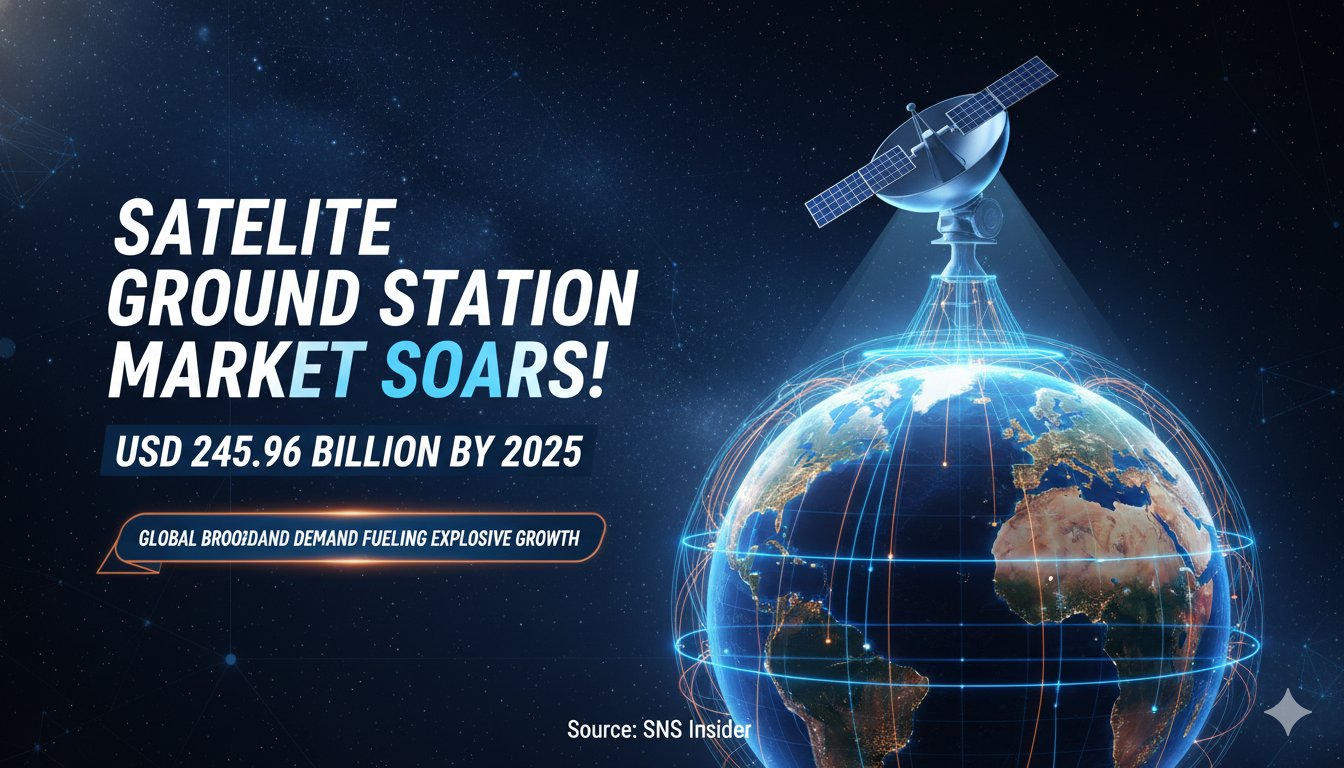
The satellite ground station market is poised for explosive expansion, projected to surge from USD 61.71 billion in 2025 to USD 245.96 billion by 2035, reflecting a robust compound annual growth rate of 14.84%. This trajectory is fueled primarily by escalating global appetite for high-speed broadband connectivity, alongside surging needs for secure defense communications, advanced Earth observation capabilities, and the proliferation of low-Earth orbit constellations that demand denser, more sophisticated ground infrastructure. Investments from both governments and private entities in automated, cloud-integrated, and software-defined systems are accelerating adoption, positioning the sector as a cornerstone of modern satellite-enabled services.
Satellite Ground Station Market Surges on Broadband Boom and Constellation Expansion
The satellite ground station sector stands at the forefront of the space economy’s transformation, serving as the critical terrestrial interface for orbiting assets. These facilities handle essential functions such as telemetry, tracking, command, data reception, and transmission, enabling everything from global broadband delivery to real-time environmental monitoring and military operations.
Current market valuation sits at USD 61.71 billion in 2025, with projections indicating a leap to USD 245.96 billion by 2035. This represents a compound annual growth rate of 14.84% over the forecast period from 2026 to 2035. The momentum stems from multiple converging forces reshaping connectivity landscapes worldwide.
A primary catalyst is the unrelenting demand for high-speed broadband access, particularly in underserved and remote regions. Traditional terrestrial networks fall short in rural areas, maritime zones, aviation routes, and disaster-prone locations, where satellite solutions offer reliable, low-latency alternatives. The rise of high-throughput satellites, especially in low-Earth orbit configurations, has amplified this need. Operators deploying massive constellations require extensive networks of ground stations to manage frequent satellite handovers, ensure continuous coverage, and process enormous data volumes generated by broadband services.
Governments and commercial players are pouring resources into upgrading infrastructure to support these demands. Advanced ground stations now incorporate multi-band antennas capable of handling diverse frequency ranges, software-defined radios for flexible operations, and automation features that reduce manual intervention and operational costs. Cloud integration further enhances scalability, allowing virtualized ground functions that can be deployed rapidly and adjusted dynamically to traffic patterns.
Defense and security applications contribute significantly to growth. Secure, resilient communications remain non-negotiable for military forces, intelligence agencies, and emergency responders. Ground stations facilitate encrypted links, real-time situational awareness, and command-and-control for satellite-based assets. Heightened geopolitical tensions and investments in space domain awareness have prompted expansions in dedicated facilities, often featuring hardened designs and redundant systems to withstand disruptions.
Earth observation emerges as another high-growth area. Satellites capturing high-resolution imagery and sensor data for climate monitoring, agriculture, urban planning, and disaster management generate petabytes of information daily. Efficient ground stations with high-bandwidth downlink capabilities and rapid processing are essential to deliver actionable insights promptly. Commercial providers expanding services to industries like insurance, energy, and logistics further intensify infrastructure requirements.
Technological advancements play a pivotal role in enabling this expansion. Software-defined ground architectures allow operators to reconfigure systems remotely, supporting multi-mission operations from a single site. Ground Station as a Service models democratize access, letting smaller entities lease capacity without massive capital outlays. Phased-array antennas and automated tracking systems improve efficiency, particularly for dynamic low-Earth orbit environments where satellites move rapidly across the sky.
Regional dynamics reveal strong leadership in North America, where substantial defense budgets, pioneering commercial constellations, and robust space industry ecosystems drive adoption. The U.S. segment alone is valued at USD 18.50 billion in 2025, with expectations to reach USD 55.13 billion by 2035 at a CAGR of 8.86%. This reflects heavy involvement in next-generation networks and public-private collaborations advancing broadband equity.
Europe and Asia-Pacific follow closely, with investments tied to sovereign satellite programs, 5G/6G integration via satellite backhaul, and initiatives bridging digital divides. Emerging markets in Latin America, Africa, and the Middle East show accelerating uptake as satellite broadband fills connectivity gaps in infrastructure-limited areas.
Key Market Segments Driving Momentum
By Platform : Fixed installations dominate due to high-capacity requirements, but portable and mobile variants gain traction for temporary deployments in disaster response and military field operations.
By Function : Communication leads, propelled by broadband and data relay needs, while Earth observation and navigation segments expand rapidly on data-intensive applications.
By Orbit : Low-Earth orbit configurations spur the most infrastructure demand, necessitating denser ground networks compared to traditional geostationary systems.
By End User : Commercial entities capture growing share through broadband and enterprise services, complemented by steady government and defense expenditures.
The sector faces challenges, including spectrum management complexities, high initial deployment costs for advanced facilities, and the need for skilled personnel to operate evolving systems. Regulatory harmonization across borders and cybersecurity enhancements remain critical to sustain momentum.
Overall, the satellite ground station market’s trajectory underscores its indispensable role in an increasingly connected world. As satellite constellations multiply and data demands soar, ground infrastructure evolves from supporting role to strategic enabler, underpinning innovations in connectivity, security, and global intelligence.
Disclaimer : This is a news and market analysis report based on industry trends and projections. It is for informational purposes only and does not constitute financial, investment, or professional advice.