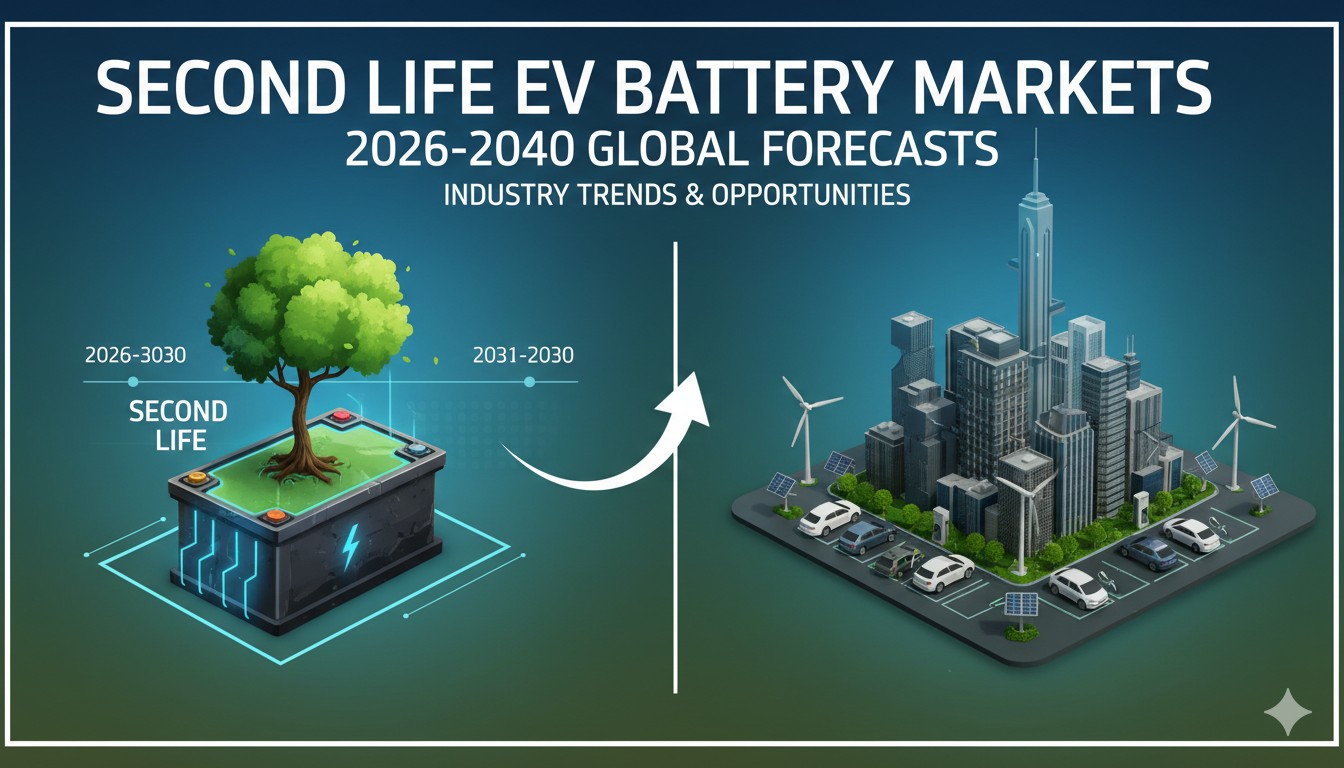
**> The second-life EV battery sector stands at the intersection of circular economy principles and the energy transition, transforming retired automotive batteries into valuable assets for stationary applications. From a current valuation around $1.7 billion in 2026, the market is forecasted to surge to over $224 billion by 2040 at a compound annual growth rate exceeding 41%, fueled by exponential EV adoption, cost advantages over new batteries, and supportive policies promoting sustainability and resource efficiency. **
Second Life EV Battery Markets, 2026-2040: Industry Trends and Global Forecasts
The repurposing of electric vehicle (EV) batteries for second-life applications represents one of the most promising developments in the broader energy storage landscape. As millions of EVs hit the roads annually, batteries that no longer meet stringent automotive performance requirements—typically retaining 70-80% of original capacity—emerge as a low-cost resource for less demanding uses. These include grid-scale energy storage, renewable integration, peak shaving, backup power, and commercial/residential systems.
Lithium-ion batteries, which power the vast majority of modern EVs, form the core of this market. Other types like nickel-metal hydride or lead-acid play minor roles but are overshadowed by the scale of lithium-ion retirements. Applications focus primarily on non-automotive stationary uses: grid-connected storage for frequency regulation and arbitrage, renewable energy smoothing (pairing with solar/wind farms), EV charging infrastructure support, and power backup in industrial or commercial settings.
Key drivers propelling this expansion include the sheer volume of retiring batteries. Global EV sales growth has accelerated, with battery demand projected to reach multi-terawatt-hour levels by the 2030s and beyond. This creates an abundant feedstock supply chain. Second-life batteries can cost 30-70% less than new ones for equivalent storage, making them attractive for utilities, developers, and end-users facing high upfront costs in energy storage projects.
Regulatory tailwinds are strengthening. Policies emphasizing circular economy principles, extended producer responsibility, and reduced waste push automakers and battery producers toward repurposing before recycling. In regions with aggressive net-zero targets, incentives for sustainable storage solutions further accelerate adoption. Technological advancements in battery diagnostics, automated testing, and modular repackaging have lowered barriers to entry, enabling faster scaling of second-life systems.
Market segmentation reveals lithium-ion’s dominance, expected to capture the lion’s share due to its energy density and cycle life advantages even in degraded states. Stationary applications like renewable energy storage and grid services lead demand, as these tolerate the reduced performance of second-life packs. End-use industries span commercial (e.g., data centers, retail), industrial (manufacturing, logistics), and residential (home energy management), with commercial and industrial segments growing fastest amid corporate sustainability goals.
Regionally, North America and Europe lead early adoption through supportive frameworks and high renewable penetration. Asia-Pacific, home to massive EV production, is poised for rapid catch-up as domestic retirements rise and local energy needs expand. Emerging markets in Latin America and the Middle East & Africa show potential as grid infrastructure modernizes.
Challenges persist. Battery health assessment lacks full standardization, complicating valuation and warranties. Logistics for collection, testing, and redistribution add costs, while safety concerns around degraded cells require robust protocols. Competition from new, low-cost battery technologies (e.g., advancements in LFP or sodium-ion) could pressure second-life economics in some segments, though repurposing remains complementary rather than substitutive.
Despite hurdles, the outlook remains robust. Cumulative retired EV battery capacity is set to grow dramatically, providing feedstock that aligns with exploding stationary storage demand. As costs decline through scale and innovation, second-life solutions will capture a larger share of the multi-trillion-dollar energy transition pie.
Market Size and Growth Projections
2026 Market Size : Approximately $1.7 billion
Projected 2040 Market Size : $224.24 billion
CAGR (2026-2040) : 41.72%
This trajectory reflects accelerating feedstock availability post-2030, when early mass EV adoption waves retire, combined with maturing supply chains and policy support.
Key Trends Shaping the Market
Cost Competitiveness — Second-life packs deliver significant savings, enabling broader deployment in cost-sensitive markets like utility-scale projects.
Circular Economy Integration — Repurposing extends battery life, reduces raw material demand, and lowers environmental footprint before eventual recycling.
Renewable Energy Synergies — Pairing with solar and wind addresses intermittency, supporting grid stability in high-renewable grids.
Technological Maturation — Improved diagnostics, AI-driven health monitoring, and modular designs enhance reliability and scalability.
Policy and Incentive Momentum — Regulations mandating sustainable battery management and incentives for green storage drive investment.
The second-life EV battery market is transitioning from niche to mainstream, playing a pivotal role in affordable, sustainable energy storage through 2040.
Disclaimer: This is a news and analysis report based on industry trends and forecasts. It does not constitute financial, investment, or professional advice.