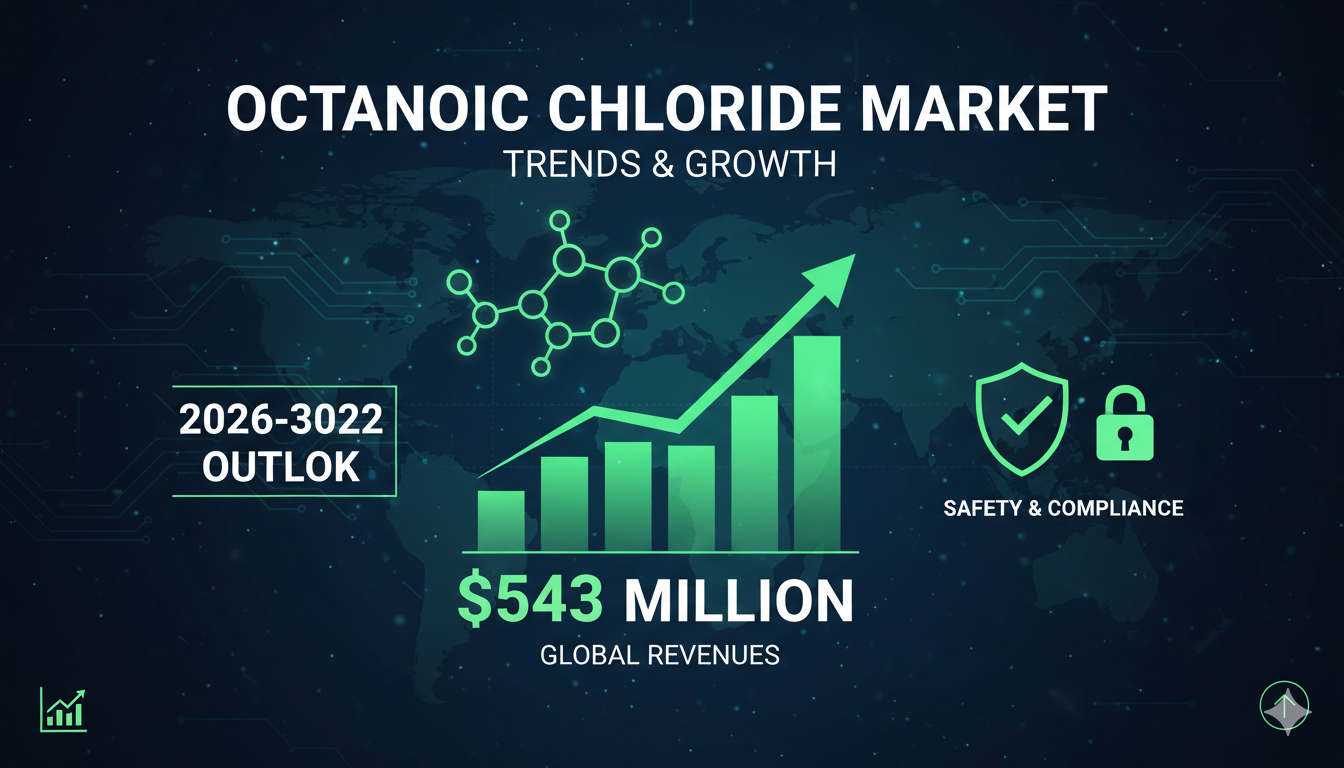
“The global octanoic chloride market is set for steady expansion, rising from $392 million in 2026 to $543 million by 2032 at a 5.74% CAGR, fueled by heightened safety protocols and regulatory compliance demands across pharmaceuticals, agrochemicals, and chemical synthesis sectors. Asia-Pacific emerges as the fastest-growing region, while North America maintains dominance with robust industrial applications.”
The octanoic chloride market is experiencing a shift toward high-value formulations, with manufacturers prioritizing quality procurement, process enhancements, and innovative production methods. Emphasis on impurity control, assay consistency, and lot reproducibility is reshaping supply chains, as end-users demand greater traceability and sustainability. Rapid innovation cycles are supported by agile sampling protocols and quick certificate of analysis turnarounds, enabling closer technical collaborations between suppliers and buyers. Customer preferences are evolving from basic supply security to assured logistics, with consistent lead times and comprehensive support becoming critical differentiators.
Key market trends also highlight a push for “right-first-time” manufacturing, process intensification, and cleaner handling of reactive gases. Moisture-resistant packaging solutions are gaining traction to mitigate risks associated with the compound’s high reactivity. Sustainability initiatives, including eco-friendly sourcing and reduced environmental footprints, are integrating into core operations, aligning with broader industry moves toward green chemistry.
Regional Growth Outlook
North America holds the largest market share, driven by advanced pharmaceutical and agrochemical sectors. The region’s focus on research and development, coupled with stringent environmental regulations, supports steady growth. Projections indicate North America will contribute approximately 35% of global revenues by 2032, with the United States leading due to investments in innovative chemical processes and compliance-driven manufacturing.
Europe follows closely, emphasizing sustainability and regulatory adherence under frameworks like REACH. Germany and the United Kingdom are key hubs, where demand for high-purity octanoic chloride in drug synthesis and intermediates bolsters expansion. The region is expected to account for around 30% of the market, with growth tempered by high operational costs but buoyed by eco-innovations.
Asia-Pacific stands out as the fastest-growing area, with a projected CAGR exceeding 8% through 2032. Rapid industrialization in China and India, along with rising agrochemical needs for crop protection, drives this surge. Government policies promoting chemical manufacturing and food security further accelerate adoption, positioning the region to capture over 25% of global revenues.
Latin America shows moderate growth, primarily from agricultural applications in Brazil, where octanoic chloride aids in emulsifiers and intermediates. The region is forecasted to represent about 15% of the market, with opportunities tied to expanding food additive sectors.
The Middle East and Africa remain smaller contributors at roughly 10%, but investments in chemical infrastructure in the UAE and South Africa are fostering gradual increases, focused on industrial end-uses.
Key Drivers and Opportunities
| Region | 2026 Revenue ($ Million) | 2032 Revenue ($ Million) | CAGR (%) |
|---|---|---|---|
| North America | 137 | 190 | 5.6 |
| Europe | 118 | 163 | 5.5 |
| Asia-Pacific | 98 | 136 | 8.2 |
| Latin America | 59 | 81 | 5.8 |
| Middle East & Africa | 39 | 54 | 5.7 |
A primary catalyst is the intensified focus on safety and compliance, given octanoic chloride’s reactive nature. Stringent handling protocols, supplier qualifications, and manufacturing standards are mandatory, with end-use documentation requirements tightening globally. This has spurred investments in safer transportation, water content controls, and stability measures, turning potential challenges into competitive advantages.
Opportunities abound in differentiated products with tailored functional properties, particularly in pharmaceuticals for active ingredient synthesis amid rising chronic disease treatments. Agrochemicals benefit from enhanced crop yields and food security demands, while chemical intermediates see uptake in efficient processes. Supply chain resilience against trade fluctuations and geopolitical risks is another growth avenue, encouraging diversified sourcing and validated logistics.
Market Segmentation Insights
By purity, the 98% segment dominates, holding over 60% share due to its versatility in synthesis applications, while 99% gains ground in high-precision pharma uses.
Applications break down with pharmaceuticals leading at 50-60%, driven by API production; agrochemicals follow at 20-30% for emulsifiers and protectors; and chemical intermediates/others comprise the rest, including food additives.
End-uses skew toward industrial sectors at 70%, with non-industrial and consumer applications growing faster through specialized formulations.
Challenges in the Market
High reactivity poses ongoing handling risks, necessitating advanced protocols that elevate costs. Regulatory scrutiny on environmental impacts and documentation precision adds operational hurdles, particularly in volatile trade environments. Supply chain disruptions from raw material shortages or geopolitical tensions remain a concern, prompting needs for robust qualification and stability measures.
Disclaimer: This news report is for informational purposes only and does not constitute financial advice or tips. Sources are based on publicly available information.