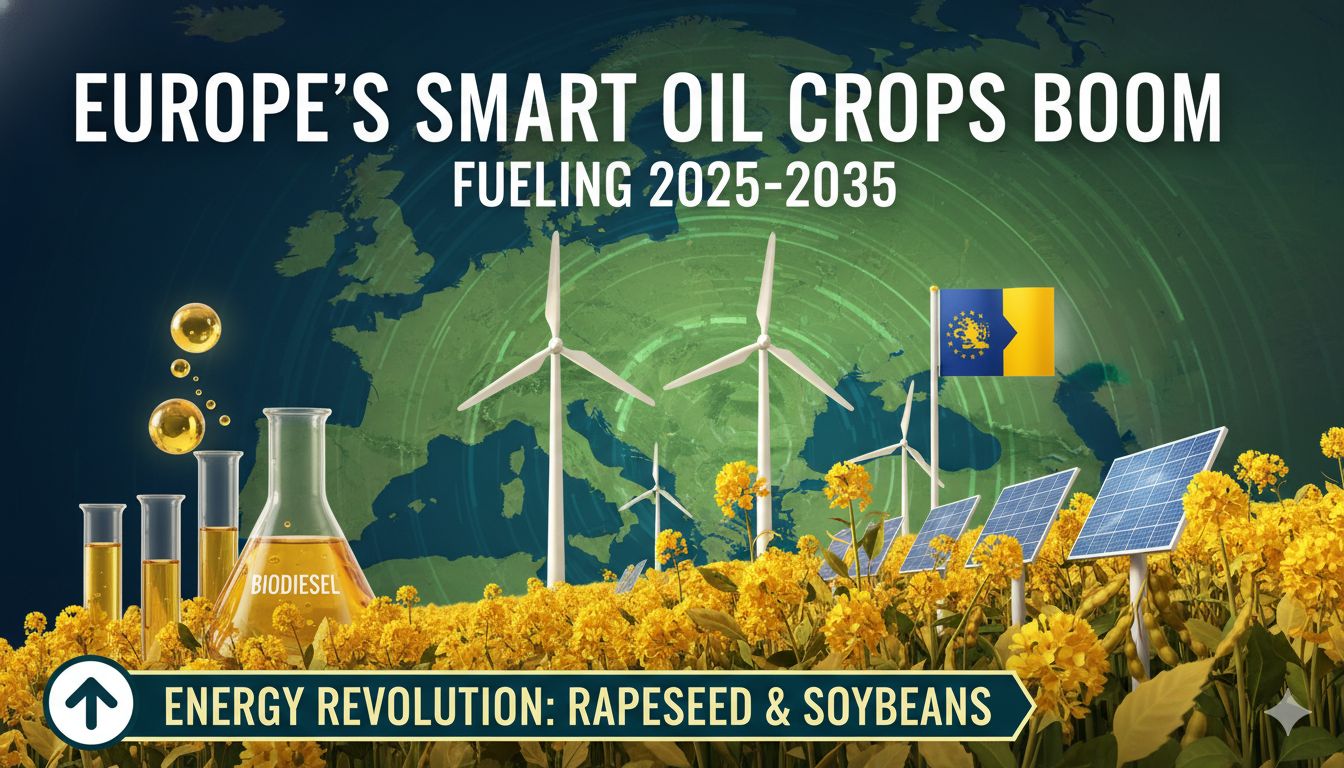
“The European smart oil crops sector is on track for robust expansion, with market value climbing from $292.2 million in 2024 to $721.2 million by 2035 at an 8.59% CAGR. Driven by surging biodiesel demand and renewable energy mandates, high-yield crops such as rapeseed and soybeans are seeing increased adoption through precision technologies, enhancing efficiency and sustainability across the continent.”
Market Overview and Growth Projections
The European smart oil crops market, integrating advanced technologies like IoT, AI, and precision farming into oilseed production, stands at a pivotal juncture. Valued at $292.2 million in 2024, the sector is forecasted to expand significantly over the next decade, reaching $721.2 million by 2035. This growth trajectory reflects a compound annual growth rate of 8.59%, underpinned by the continent’s push toward sustainable agriculture and energy independence.
Globally, the smart oil crops arena mirrors this momentum, starting from $0.96 billion in 2025 and projected to hit $2.68 billion by 2035 at a 10.8% CAGR. Europe’s share emphasizes its role in pioneering tech-driven farming solutions, particularly for oil-rich varieties that feed into biofuel production chains.
Key Drivers Fueling Expansion
Rising biodiesel consumption is a primary catalyst, with European biofuel markets valued at $26.57 billion in 2024 and expected to grow to $43.42 billion by 2033. Biodiesel alone is anticipated to see production peak at 20.7 billion liters in 2028 before stabilizing around 16.4 billion liters by 2035, as policies shift toward advanced feedstocks. This demand directly boosts the need for efficient oil crop cultivation, where smart systems optimize yields and reduce inputs.
Renewable energy policies, including the EU Green Deal and Farm-to-Fork strategies, mandate lower emissions and enhanced biodiversity, favoring tech-enhanced farming. These initiatives promote reduced chemical usage and climate-resilient practices, aligning with broader goals to phase out unsustainable imports like palm oil, which is projected to drop 53.3% in biofuel use due to environmental concerns.
Additionally, volatility in global oil prices—currently influencing biofuel competitiveness—encourages domestic production of oilseeds. High energy costs and macroeconomic pressures further incentivize precision tools that cut operational expenses by enabling real-time monitoring of soil, weather, and crop health.
Crop-Specific Insights: Rapeseed and Soybeans in Focus
Rapeseed remains the cornerstone of Europe’s oil crop landscape, accounting for roughly 39% of biodiesel feedstocks in the early forecast period, dipping slightly to 37% by 2035. Production is expected to hold steady at approximately 18.4 million tons annually, supported by stable cultivated areas despite challenges from climate variability and input costs. Its dominance in biodiesel—comprising over 50% of German production, for instance—highlights its efficiency in yielding high-quality oil and meal byproducts for feed.
Soybeans, meanwhile, are poised for stronger growth, with production rising at 0.7% per year through area expansion and policy incentives for plant-based proteins. Crushing volumes are forecasted to increase to 14.5 million tons by 2035, up 0.9%, driving soybean oil output higher by 5%. This crop’s versatility in biodiesel and industrial applications makes it a key beneficiary of smart farming, where AI-driven analytics improve drought resistance and nutrient management.
Other oilseeds like sunflower contribute modestly, with production growing 0.2% annually, aided by their lower cost profile and adaptability to precision techniques.
Regional Dynamics and Investment Opportunities
| Crop | Current Production (Million Tons) | Projected Production by 2035 (Million Tons) | Annual Growth Rate | Key Application in Biodiesel |
|---|---|---|---|---|
| Rapeseed | 18.4 | 18.4 | 0% (Stable) | Dominant feedstock, 37-39% share |
| Soybeans | ~3.0 (Estimated based on trends) | Increasing to meet demand | 0.7% | Growing role in blends, 5% oil output rise |
| Sunflower | ~10.0 | Modest increase | 0.2% | Supplementary, stable oil production |
Germany leads in biodiesel output, with production slightly up in recent periods and rapeseed-based fuel holding a 53.1% share. Soybean harvests there are set for records, bolstered by imports totaling 3.6 million tons to meet protein demands. France and Spain follow, leveraging smart equipment for yield optimization in rapeseed-heavy regions.
Ukraine, despite geopolitical factors, contributes through sunflower dominance, while the rest of Europe focuses on integrated systems and software for farm management. Overall oilseed production across the EU is slated to reach 36.1 million tons by 2035, a 2.5% increase, with areas expanding 2% to 14 million hectares.
For U.S. investors, this market presents avenues in tech exports, such as AI platforms and drones, amid transatlantic trade in biofuels. European self-sufficiency efforts could impact global soybean and rapeseed prices, offering hedging opportunities in commodity futures.
Forecast Challenges and Outlook
Uncertainties include yield variability—13.6% coefficient for soybeans—and price fluctuations driven by energy costs (baseline $84 per barrel). Low oil prices could temper biofuel demand, while high scenarios boost crop prices by 7%. Environmental shifts, like reduced erosion risk through crop rotation, support long-term viability.
Biodiesel demand is expected to peak at 22.8 billion liters in 2028 before declining to 18.2 billion by 2035, necessitating imports of 2 billion liters annually. This underscores the role of smart technologies in maintaining competitiveness, with waste oils rising to 50% of feedstocks, complementing crop-based sources.
| Year Milestone | Biodiesel Production (Billion Liters) | Biodiesel Use (Billion Liters) | Key Trend |
|---|---|---|---|
| 2028 (Peak) | 20.7 | 22.8 | Short-term growth from mandates |
| 2035 | 16.4 | 18.2 | Shift to advanced feedstocks |
| Overall EU Biofuels Market Value | – | $43.42 billion by 2033 | Sustained renewable push |
Disclaimer: This news report provides general information and tips based on various sources.