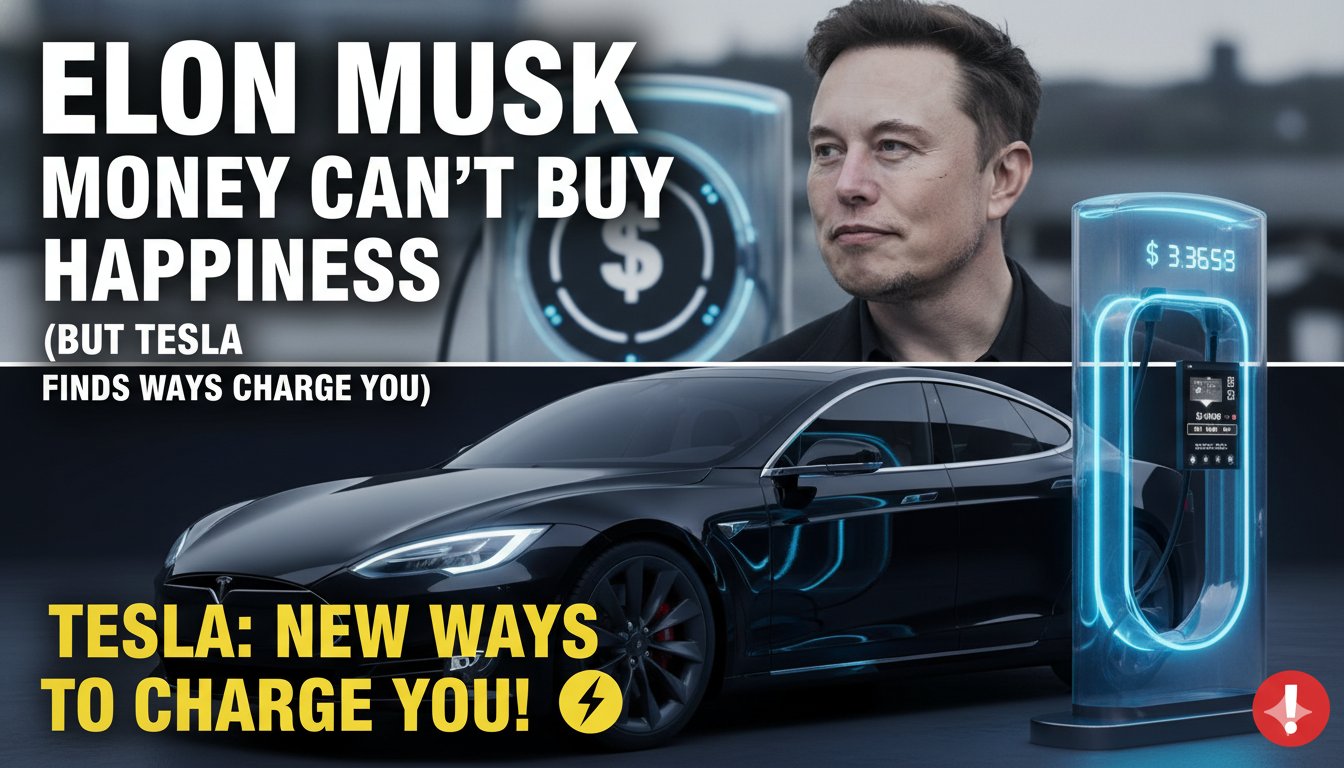
“Elon Musk reflects on the limits of wealth in achieving personal happiness amid his soaring net worth, while Tesla innovates in EV charging with network expansions, new software features, and partnerships that boost revenue streams for the company.”
Elon Musk, the visionary behind Tesla and SpaceX, recently shared a poignant reflection on social media that has ignited widespread discussion among investors, entrepreneurs, and everyday Americans grappling with economic pressures. With his net worth surpassing $850 billion—making him the wealthiest individual on the planet—Musk’s admission underscores a timeless debate in financial circles: the disconnect between material success and emotional fulfillment. This comes at a pivotal moment for Tesla, where advancements in charging technology and infrastructure are not only revolutionizing electric vehicle adoption but also creating lucrative new revenue avenues.
Musk’s net worth has ballooned thanks to Tesla’s stock performance, which hit all-time highs in early 2026, driven by robust sales of models like the Cybertruck and Model Y. Yet, his candid statement highlights the psychological toll of relentless ambition. Financial analysts note that ultra-high-net-worth individuals often face unique stressors, including constant public scrutiny and the burden of managing vast empires. Musk’s wealth, primarily tied to Tesla shares valued at over $1.5 trillion in market cap, exemplifies how stock volatility can amplify personal anxieties, even as it generates immense paper gains.
Shifting focus to Tesla’s operational strides, the company is pioneering “new ways to charge” that extend beyond literal battery replenishment to innovative billing and access models. Tesla’s Supercharger network, the backbone of its EV ecosystem, has expanded aggressively, adding over 3,800 new stalls in the final quarter of 2025 alone. This brings the global total to 8,182 stations and 77,682 connectors, representing a 19% year-over-year increase in capacity. In the U.S., where EV adoption is surging amid federal incentives from the Inflation Reduction Act, Tesla’s network now accounts for more than half of all fast-chargers, with nearly 37,000 ports nationwide.
A key innovation is the opening of Superchargers to non-Tesla vehicles, a strategy that began in earnest in 2025 and continues into 2026. Automakers like Ford, GM, Rivian, Lucid, Lexus, Kia, Honda, Acura, Jaguar Land Rover, Audi, Porsche, Toyota, Volkswagen, Subaru, and BMW have integrated North American Charging Standard (NACS) compatibility, allowing their drivers to tap into Tesla’s infrastructure. This interoperability not only accelerates EV market growth but also positions Tesla as a dominant player in charging services, akin to a utility provider. Revenue from third-party charging fees is projected to reach billions annually, with analysts estimating $2-3 billion in 2026 alone from access agreements and per-kWh billing.
Tesla’s latest software update, version 2026.2.3, introduces the “Unlatch Charge Cable” feature, enabling drivers to release a stuck charger by holding the rear left door handle for three seconds when the vehicle is unlocked. This user-friendly enhancement addresses common frustrations at public stations, improving the overall charging experience for American commuters who rely on EVs for daily travel. In urban areas like Los Angeles and New York, where charging availability can make or break EV ownership, such features are critical for maintaining consumer confidence.
On the heavy-duty front, Tesla has forged a partnership with Pilot Travel Centers to deploy Semi Chargers along major U.S. highways. Construction is set to begin in the first half of 2026 at sites in California, Georgia, Nevada, New Mexico, and Texas, targeting fleet operators transitioning to electric trucks. The Tesla Semi, with its 500-mile range and rapid charging capabilities, stands to benefit from this infrastructure, potentially reducing logistics costs for companies like PepsiCo and UPS, which have already piloted the vehicles. This move aligns with broader U.S. goals for sustainable transport, as the Biden-Harris administration’s investments in clean energy aim to electrify freight corridors by 2030.
Financially, these charging initiatives are transforming Tesla’s business model. Traditionally reliant on vehicle sales, the company is diversifying into services and energy. The Supercharger network delivered a record 6.7 terawatt-hours of energy in 2025, a metric that underscores its scale and efficiency. With average charging sessions costing $0.28 per kWh in the U.S.—varying by state due to electricity rates—Tesla’s margins on this segment are robust, often exceeding 30% after accounting for maintenance and expansion costs. Investors should note that as more non-Tesla EVs join the network, utilization rates could climb 20-30%, further bolstering recurring revenue.
To illustrate Tesla’s charging dominance, consider the following breakdown of network growth and accessibility:
| Category | 2025 End-of-Year Totals | Year-Over-Year Growth | U.S. Market Share |
|---|---|---|---|
| Supercharger Stations | 8,182 | +17% | 52% of fast-chargers |
| Connectors | 77,682 | +19% | N/A |
| New Stalls Added (Q4 2025) | 3,800+ | Record high | N/A |
| Third-Party Automaker Access | 12+ brands | Expanded from 2025 | Growing to Stellantis in 2026 |
This table highlights how Tesla’s infrastructure investments are paying dividends, with large-scale sites like the 164-stall station in Lost Hills, California, powered by solar energy, exemplifying sustainable scalability.
Beyond hardware, Tesla is advancing software-driven charging optimizations. Features like Plug & Charge—now standard in 2026 models—allow seamless authentication and payment without apps or cards, streamlining the process for busy professionals. For home charging, the Wall Connector remains a bestseller, adding up to 44 miles of range per hour, while the Mobile Connector offers flexibility for on-the-go needs. These products generate additional income through direct sales and over-the-air updates that enhance functionality over time.
In the competitive landscape, rivals like Electrify America and EVgo are ramping up 350kW fast-chargers, but Tesla’s ecosystem advantage lies in its integration with vehicle navigation. Tesla owners in the U.S. can precondition batteries en route to chargers, minimizing wait times and maximizing efficiency— a boon for cross-country road trips. As EV sales are expected to hit 2 million units in the U.S. in 2026, up 15% from 2025, Tesla’s charging prowess will likely solidify its market leadership, with projections showing 25% of new vehicle sales being electric.
Musk’s reflection also ties into broader economic themes affecting American households. While his wealth insulates him from everyday financial woes, rising inflation and interest rates have made happiness a luxury for many. Financial advisors often counsel that beyond a $100,000 annual income threshold, additional earnings yield diminishing returns on well-being. Musk’s empire, however, continues to innovate, with charging advancements ensuring Tesla remains a growth engine in the green economy.
Key points from Tesla’s 2026 trajectory include:
Network Interoperability : Full NACS adoption by major automakers, enabling cross-brand charging and fostering industry-wide standards.
Fleet Electrification : Semi Charger rollout with Pilot, targeting interstate trucking routes to cut emissions and operational costs.
User Experience Upgrades : Software features like automatic cable unlatching and intelligent routing to reduce downtime.
Revenue Diversification : Shifting from pure auto sales to services, with charging poised to contribute 10-15% of total revenue by decade’s end.
These developments position Tesla not just as a carmaker but as an energy solutions provider, capitalizing on the U.S. push toward net-zero emissions. For investors, this duality—Musk’s personal candor juxtaposed with corporate innovation—offers a compelling narrative in volatile markets.
Disclaimer: This article is for informational purposes only and does not constitute financial advice, investment recommendations, or endorsements. All data and opinions are based on publicly available information and should not be relied upon for making decisions. Consult a qualified professional for personalized guidance.