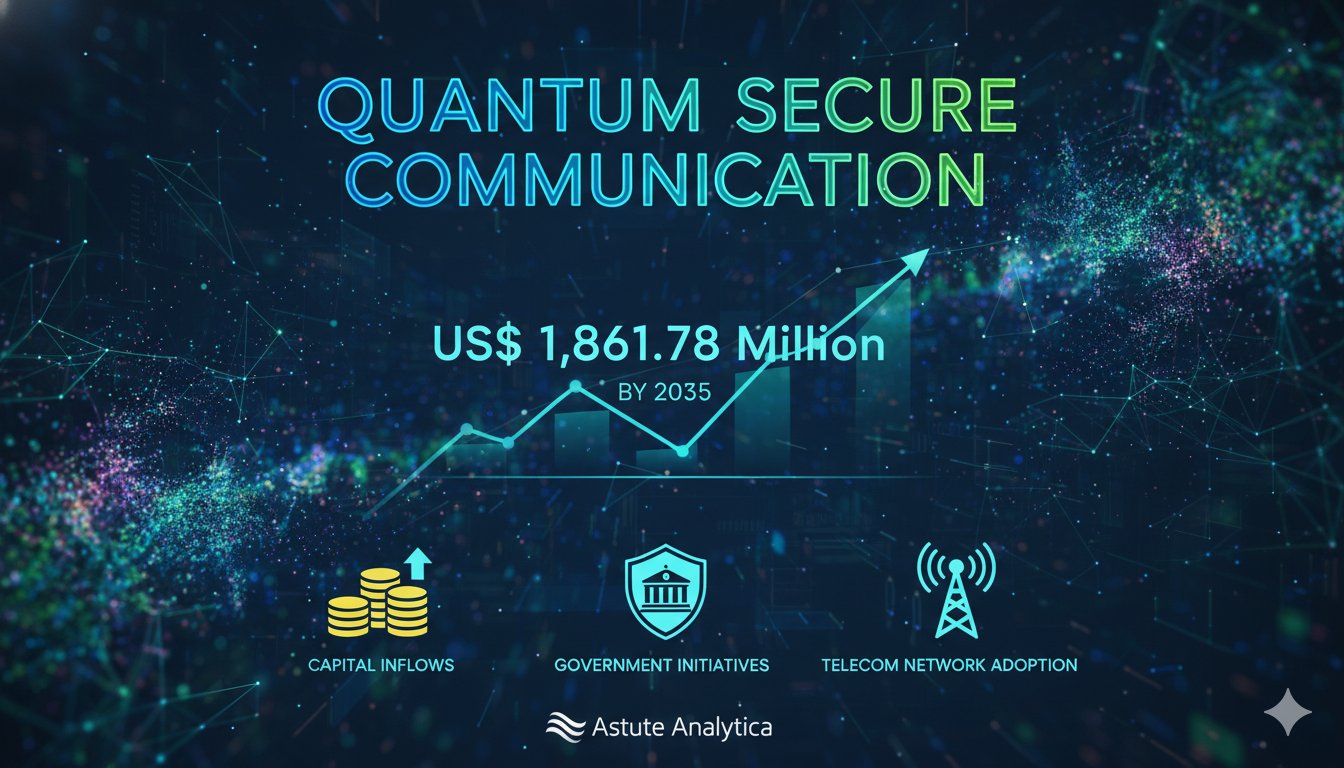
“The global quantum secure communication market, valued at $595.39 million in 2025, is forecasted to surge to $1,861.78 million by 2035, achieving a robust CAGR of 12.3%. This expansion is propelled by substantial capital investments, proactive government policies, and widespread integration into telecommunications infrastructures, with quantum key distribution leading hardware advancements and post-quantum cryptography gaining traction in software solutions across sectors like finance, defense, and government.”
Market Dynamics and Projections
The quantum secure communication sector stands at the forefront of next-generation cybersecurity, addressing vulnerabilities posed by advancing computational capabilities. Hardware components, particularly those enabling quantum key distribution (QKD), dominate the landscape, capturing over 55% of the market share due to their role in establishing unbreakable encryption channels. Software solutions, including post-quantum cryptography (PQC) algorithms, are rapidly evolving to complement existing infrastructures without requiring full hardware overhauls.
Projections indicate a steady upward trajectory, with the market’s valuation expected to more than triple over the decade. This growth reflects a compound annual rate that outpaces traditional cybersecurity segments, driven by the imperative to safeguard sensitive data against emerging threats. In the United States, adoption is accelerating in critical industries, where regulatory frameworks are pushing for quantum-resistant protocols to protect national interests.
Key Growth Drivers
Capital inflows are a primary catalyst, with venture funding and private equity pouring into startups and established players specializing in quantum technologies. Investments have surged as institutional investors recognize the long-term potential of quantum-secure systems in mitigating risks from sophisticated cyberattacks. For instance, funding rounds in recent periods have targeted innovations in satellite-based QKD, enabling global secure links that bypass traditional fiber vulnerabilities.
Government initiatives play a pivotal role, with agencies allocating budgets for research and deployment. In the U.S., federal programs are channeling resources into quantum infrastructure, including partnerships with tech firms to build resilient networks. These efforts aim to counter geopolitical risks, ensuring secure communications for diplomatic, military, and economic channels. Policies mandating quantum-ready encryption in public sectors are further accelerating market penetration.
Telecom network adoption is another cornerstone, as operators integrate quantum solutions to enhance data transmission security. Major carriers are piloting QKD over existing fiber optics, reducing latency while fortifying against eavesdropping. This integration is particularly vital in 5G and emerging 6G ecosystems, where high-speed, low-interference secure channels are essential. The convergence of quantum tech with telecom infrastructure is expected to unlock new revenue streams, with service providers offering quantum-secured bandwidth as a premium feature.
Additional drivers include the rising prevalence of data breaches in financial institutions, prompting a shift toward quantum-secure alternatives. The banking sector, facing trillions in potential losses from cyber incidents, is investing heavily in QKD for transaction security. Similarly, the defense industry is prioritizing quantum teleportation for real-time, tamper-proof intelligence sharing.
Challenges and Opportunities
Despite promising growth, the sector faces hurdles such as high implementation costs and technical complexities in scaling quantum systems. Interoperability between quantum and classical networks remains a bottleneck, requiring standardized protocols to facilitate broader adoption. Supply chain dependencies on rare materials for quantum hardware also pose risks, potentially inflating prices and delaying rollouts.
Opportunities abound in hybrid models that blend QKD with PQC, offering cost-effective transitions for enterprises. The expansion of quantum networks via satellites presents a lucrative avenue, enabling cross-continental secure communications immune to physical tampering. Emerging applications in lotteries and online gaming, where integrity is paramount, are opening niche markets ripe for innovation.
Segmentation Analysis
The market is segmented by component, type, application, and region, providing a granular view of its composition.
By Component : Hardware leads with a dominant share, encompassing QKD systems, quantum repeaters, and detectors. Software follows, driven by PQC tools that retrofit legacy systems. Services, including consulting and managed security, are growing fastest, projected to expand at a CAGR exceeding 14% as organizations seek expert guidance for deployment.
By Type : Quantum key distribution holds the largest segment, utilized for generating unbreakable keys over distances. Quantum teleportation is gaining ground in specialized applications, transferring quantum states for advanced encryption.
By Application : The government and defense sector commands the highest revenue, leveraging quantum tech for classified communications. Financial and banking industries are close behind, with applications in secure transactions and fraud prevention. Business sectors, including telecom and healthcare, are emerging adopters, focusing on data privacy compliance.
Regional Insights
| Segment | 2025 Market Share (%) | Projected 2035 Market Share (%) | CAGR (2026-2035) |
|---|---|---|---|
| Hardware | 55 | 52 | 11.8% |
| Software | 30 | 32 | 12.7% |
| Services | 15 | 16 | 14.2% |
| Quantum Key Distribution | 60 | 58 | 12.0% |
| Quantum Teleportation | 40 | 42 | 13.0% |
| Government & Defense | 35 | 33 | 11.5% |
| Financial & Banking | 25 | 27 | 12.5% |
| Telecom & Business | 20 | 22 | 13.0% |
| Others | 20 | 18 | 11.0% |
North America, led by the U.S., holds the largest market share at approximately 40%, bolstered by robust R&D ecosystems and federal funding. Initiatives like national quantum strategies are fostering innovation hubs in states such as California and New York, where tech giants collaborate with universities on pilot projects.
Europe follows with a 30% share, driven by collaborative frameworks across EU member states. Countries like Germany and the UK are investing in quantum corridors, linking cities with secure fiber networks. Asia-Pacific is the fastest-growing region, with a projected CAGR of 14.5%, fueled by China’s ambitious quantum satellite programs and India’s focus on indigenous tech development.
Latin America and the Middle East & Africa represent smaller but expanding shares, with growth tied to international partnerships and telecom upgrades.
Competitive Landscape
The sector features a mix of established tech firms and innovative startups vying for dominance. Key players are focusing on strategic alliances, mergers, and R&D investments to capture market share. For example, companies specializing in QKD hardware are partnering with telecom giants to integrate solutions into existing infrastructures.
Innovation is key, with advancements in entanglement-based systems and error-corrected quantum channels setting leaders apart. Patent filings in PQC algorithms are surging, indicating intense competition in software segments. Market consolidation is anticipated as larger entities acquire niche quantum firms to broaden portfolios.
Future Outlook and Strategic Recommendations
As the market matures, emphasis on standardization will be crucial to drive mass adoption. Enterprises should prioritize hybrid quantum-classical strategies to minimize disruption during transitions. Investors are advised to target high-growth areas like satellite QKD, where scalability offers exponential returns.
The integration of quantum secure communication into everyday telecom services could democratize access, extending benefits beyond high-stakes sectors. With ongoing advancements, the sector is poised to redefine cybersecurity paradigms, ensuring data integrity in an increasingly interconnected world.
Disclaimer: This news, report, and tips are provided for informational purposes only and do not constitute financial, investment, or professional advice. The content is derived from various sources, but specific sources are not mentioned. Readers should conduct their own research and consult qualified experts before making decisions based on this information. No times or dates are mentioned to maintain general applicability.