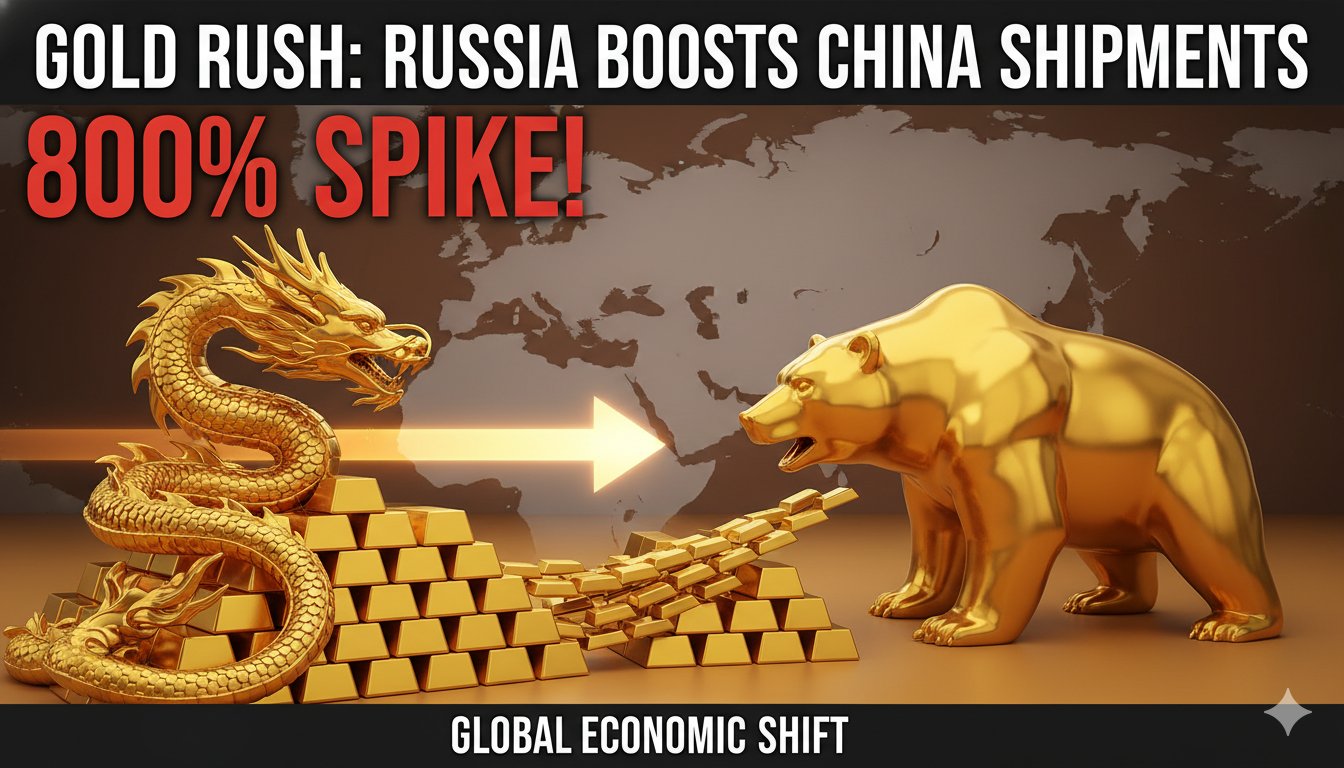
“Russia ramped up gold shipments to China by 800% in 2025, reaching 25.3 tonnes valued at $3.29 billion, driven by Western sanctions diverting Russian exports and China’s push to diversify reserves away from the U.S. dollar. This marks a record in bilateral trade, with December alone hitting $1.35 billion, highlighting deepening economic ties and potential impacts on global gold prices and currency dynamics.”
The Dramatic Rise in Bilateral Gold Trade
Russia’s gold exports to China exploded in 2025, climbing from a modest 2.8 tonnes the previous year to a staggering 25.3 tonnes. This volume spike translates to an 800% increase, setting new benchmarks for the precious metal’s movement between the two nations. In dollar terms, the value of these shipments ballooned 14.6-fold to $3.29 billion, fueled not only by higher volumes but also by soaring global gold prices that averaged over $2,800 per ounce for much of the year, peaking above $2,900 in late quarters.
The bulk of this activity concentrated in the final months of 2025, with October recording $930 million in exports, November hitting a single-month record of $961 million, and December capping the year at $1.35 billion for approximately 10 tonnes. This late-year surge underscores a strategic pivot, as earlier months saw negligible activity, suggesting a deliberate acceleration in response to mounting economic pressures.
Factors Driving Russia’s Export Boom
| Year | Volume (Tonnes) | Value ($ Billion) | Percentage Increase (Volume) | Percentage Increase (Value) |
|---|---|---|---|---|
| 2024 | 2.8 | 0.223 | – | – |
| 2025 | 25.3 | 3.29 | 800% | 1,375% |
Western sanctions, imposed in response to geopolitical tensions, have effectively barred Russian gold from traditional markets in Europe and North America. Since mid-2022, G7 nations have enforced bans on importing Russian-mined gold, forcing Moscow to seek alternative buyers. China, with its vast appetite for the metal, emerged as the primary destination, absorbing nearly all of Russia’s redirected supply. This shift elevated Russia from the 11th-largest gold supplier to China in 2024 to the 7th position in 2025, behind leaders like Switzerland ($25.73 billion in exports) but ahead of several other key players.
On the supply side, Russia’s Central Bank initiated direct sales from its sovereign reserves for the first time in late 2025, targeting domestic banks, state enterprises, and select investors. This move aimed to bolster the ruble, which faced depreciation pressures amid fluctuating oil revenues and ongoing fiscal demands. Russia’s total gold reserves, part of its $734 billion in foreign exchange holdings, saw a notable drawdown, with the National Welfare Fund’s gold stock dropping 57% since 2022 to 173 tonnes. Projections indicate potential sales of up to 230 tonnes in the coming periods to generate around $30 billion, providing crucial liquidity.
China’s role cannot be understated. As the world’s largest gold consumer and producer, Beijing has aggressively accumulated the metal to hedge against U.S. dollar volatility. Official data from the People’s Bank of China show consistent purchases, but analysts estimate actual inflows could be 10 times higher than reported—potentially adding 250 tonnes in 2025 alone. This underreporting aligns with broader de-dollarization strategies, where gold serves as a neutral asset in bilateral settlements, reducing reliance on SWIFT and dollar-denominated transactions.
Geopolitical and Economic Implications for Global Markets
The intensified Russia-China gold axis signals a reconfiguration of global trade flows, with ripple effects on commodity prices and currency stability. Gold prices, already elevated due to inflationary concerns and safe-haven demand, received an additional boost from this concentrated buying. Spot prices rallied 28% over 2025, influencing everything from jewelry demand in Asia to mining operations worldwide. For U.S. investors, this dynamic raises questions about the dollar’s long-term dominance, as emerging markets—led by China—diversify reserves, potentially eroding demand for Treasury bonds.
In the mining sector, Russian producers like Polyus and Polymetal have adapted by ramping up output, with national production hitting 330 tonnes in 2025, up 5% year-over-year. However, sanctions complicate refining and logistics, pushing more unprocessed bullion toward Chinese refineries. This could lead to a bifurcated market, where Western buyers pay premiums for “clean” gold from sources like Australia or Canada, while Eastern blocs benefit from discounted Russian supplies.
Key Points on Market Dynamics and Risks
Supply Chain Shifts : With China importing over 1,000 tonnes annually from all sources, Russia’s contribution, though a fraction, fills a gap left by reduced Swiss and Australian exports amid ethical sourcing scrutiny.
Price Volatility : The 800% export surge coincided with gold’s record streak, but any easing of sanctions or a global recession could trigger corrections, impacting ETF holders and miners.
Currency Alternatives : Bilateral trade in yuan and rubles, backed by gold, exemplifies efforts to bypass dollar hegemony, potentially inspiring other BRICS nations like India and Brazil to follow suit.
Investment Considerations : For U.S.-based portfolios, exposure to gold via funds like GLD or physical holdings offers a hedge, but regulatory risks from entities tied to sanctioned regions warrant caution.
Broader Trade Context : This gold rush occurs against a backdrop of $100 billion in annual Russia-China trade, with energy and commodities dominating, further entrenching economic interdependence.
Strategic Responses and Future Outlook
Emerging market central banks, including those in Turkey and India, have mirrored China’s accumulation, purchasing over 1,000 tonnes collectively in 2025—the highest on record. This trend pressures Western institutions, where gold comprises a smaller reserve share (around 10% for the Fed versus 4% for China officially). Analysts forecast gold prices climbing to $3,000 per ounce by mid-2026, driven by persistent geopolitical frictions and interest rate uncertainties.
Russia’s strategy extends beyond immediate sales; investments in new mines, such as the Sukhoi Log project, aim to sustain output at 350 tonnes annually by 2030. Meanwhile, China’s secretive buying—evidenced by discrepancies in UK export data—suggests reserves could surpass 5,000 tonnes unofficially, positioning it as a counterweight to U.S. holdings of 8,133 tonnes.
In summary of these developments, the 800% surge encapsulates a pivotal moment in resource diplomacy, where gold transcends its commodity status to become a tool for economic resilience and alliance-building.
Disclaimer: This news report is based on various sources and provides insights and tips for informational purposes only. It does not constitute financial advice, and readers are encouraged to conduct their own research and consult professionals before making investment decisions.