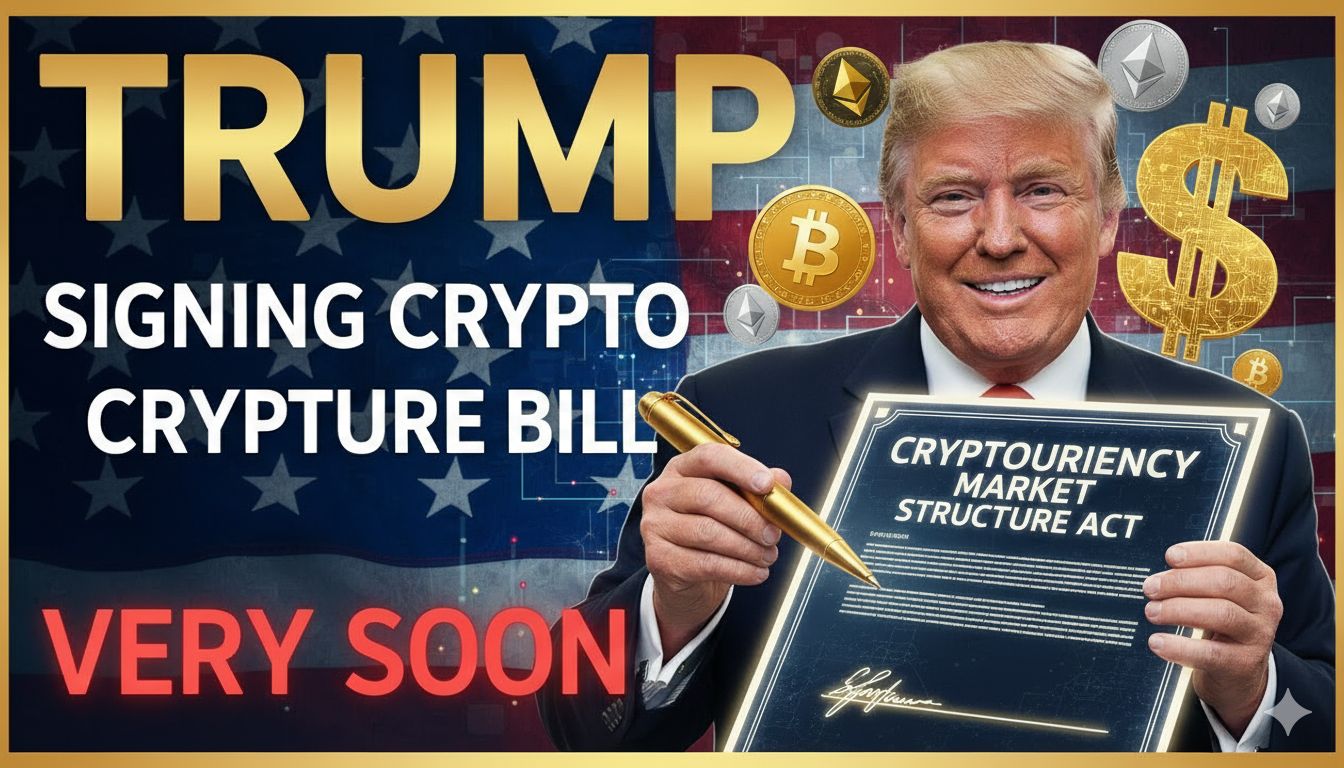
“President Donald Trump expressed optimism about signing a comprehensive crypto market structure bill soon during his World Economic Forum speech, positioning it as a key step to solidify U.S. leadership in digital assets over rivals like China, following last year’s stablecoin legislation, amid positive market reactions and industry endorsements.”
President Donald Trump took the stage at the World Economic Forum to highlight his administration’s aggressive push toward establishing the United States as the undisputed leader in cryptocurrency and digital assets. He emphasized that Congress is advancing legislation on crypto market structure, encompassing Bitcoin and other digital currencies, which he anticipates signing into law without delay. This move builds on prior regulatory efforts and aims to create a framework that fosters innovation while ensuring American dominance in the sector.
The proposed bill, known as the CLARITY Act, seeks to clarify regulatory jurisdictions by dividing oversight between the Securities and Exchange Commission for security-like tokens and the Commodity Futures Trading Commission for commodities such as Bitcoin. This division addresses long-standing ambiguities that have hampered industry growth, allowing for more streamlined trading, custody, and issuance of digital assets. Proponents argue it will unlock institutional capital by providing legal certainty, potentially integrating crypto more deeply into traditional financial systems.
Key Provisions of the CLARITY Act
Regulatory Split : The SEC would handle tokens deemed securities, focusing on investor protection and disclosure requirements, while the CFTC oversees commodity-based assets like Bitcoin, emphasizing market integrity and anti-manipulation measures.
Stablecoin Enhancements : Building on the GENIUS Act, which legalized and regulated stablecoins tied to the U.S. dollar, the new bill includes provisions for interest-bearing stablecoins, allowing issuers to offer yields to holders, though debates persist over reward structures.
Bank Integration : The legislation paves the way for U.S. banks to engage directly in crypto activities, such as custody and trading, potentially merging traditional banking with digital assets into a unified industry.
Anti-China Measures : Explicit clauses aim to restrict foreign influence, particularly from China, by limiting access to U.S. markets for entities tied to adversarial nations, aligning with broader national security goals.
Innovation Safeguards : Requirements for decentralized finance platforms to register under lighter-touch regimes, promoting growth in areas like tokenized real estate and supply chain finance.
This framework is expected to catalyze a wave of institutional adoption, with estimates suggesting it could add trillions in market capitalization to the crypto sector by enabling pension funds, endowments, and retail banks to participate more freely.
Industry Leaders Weigh In
White House advisor on AI and crypto, David Sacks, elaborated on the bill’s potential during related discussions, predicting that once enacted, traditional banks will fully embrace cryptocurrencies. He envisions a future where banks issue stablecoins and integrate blockchain technology, erasing the divide between legacy finance and digital assets. Sacks highlighted stablecoins as a gateway, noting their role in efficient cross-border payments and yield generation.
Coinbase CEO Brian Armstrong echoed this sentiment, revealing meetings with executives from major banks to advocate for the bill. He noted that his platform already provides crypto infrastructure to several top-tier financial institutions, underscoring a collaborative model where competition enhances overall market efficiency rather than being stifled.
Other stakeholders, including representatives from blockchain firms, have praised the bill for its bipartisan support, having passed the House with broad consensus and now advancing through Senate committees. One committee is set to release an updated draft, while another continues refinements after a recent procedural adjustment.
Market Impact and Price Movements
The announcement triggered immediate volatility in cryptocurrency markets, with Bitcoin rebounding from session lows around $88,000 to surpass $90,000 shortly after the speech. This uptick reflects investor optimism about regulatory clarity boosting liquidity and adoption. Ethereum followed suit, climbing toward $2,900, while altcoins like Solana and Ripple saw gains of 2-4% in the ensuing hours.
| Cryptocurrency | Current Price (USD) | 24-Hour Change (%) | Market Cap (Billions USD) |
|---|---|---|---|
| Bitcoin (BTC) | 90,150 | +2.5 | 1,780 |
| Ethereum (ETH) | 2,895 | +1.8 | 348 |
| Solana (SOL) | 126 | +3.2 | 59 |
| Ripple (XRP) | 1.89 | +4.1 | 107 |
| Binance Coin (BNB) | 868 | +2.0 | 127 |
These movements come against a backdrop of broader market relief, as the speech also addressed geopolitical tensions, though crypto’s response was particularly pronounced due to the direct references.
Strategic Positioning Against Global Rivals
Trump framed the crypto push as essential to countering China’s advancements in digital currencies and blockchain. He noted that supporting such legislation not only garners political favor but also secures strategic advantages in emerging technologies like AI and decentralized networks. By prioritizing U.S.-based innovation, the bill aims to prevent foreign entities from dominating key infrastructure, such as mining operations and token standards.
This aligns with the administration’s broader economic narrative of American resurgence, including boasts of tamed inflation at 1.5% core rates and projected 5.4% quarterly growth. Energy policies, such as expanding nuclear power and accessing Venezuelan oil reserves, were tied to reducing costs that could indirectly benefit crypto mining, an energy-intensive process.
Potential Challenges and Debates
Despite the momentum, tensions remain over specific elements, such as stablecoin reward mechanisms. Some lawmakers advocate for caps on yields to prevent systemic risks, while industry groups push for flexibility to attract more users. Additionally, environmental concerns about proof-of-work mining could lead to amendments requiring sustainable practices.
The bill’s progress has been marked by intense lobbying, with crypto firms contributing significantly to political campaigns to ensure favorable outcomes. Analysts predict that once signed, it could lead to a surge in venture capital inflows, potentially rivaling the dot-com boom in scale.
Broader Implications for Financial Freedom
Trump described the legislation as unlocking pathways to financial freedom for Americans, enabling easier access to digital wallets, peer-to-peer transactions, and tokenized assets. This could democratize finance, allowing everyday investors to participate in high-yield opportunities traditionally reserved for institutions.
In tandem with monetary policy shifts, including calls for the lowest global interest rates and a new Federal Reserve chair, the crypto framework supports a risk-on environment where asset prices are bolstered. Stock market dips were dismissed as minor, with projections of doubling in value under supportive policies.
The integration of banks into crypto is seen as transformative, potentially leading to hybrid products like crypto-backed loans and blockchain-based securities. This convergence could reshape global finance, positioning the U.S. at the forefront.
Disclaimer: This news report is for informational purposes only and does not constitute financial advice or investment tips. Sources used in preparation are not mentioned.