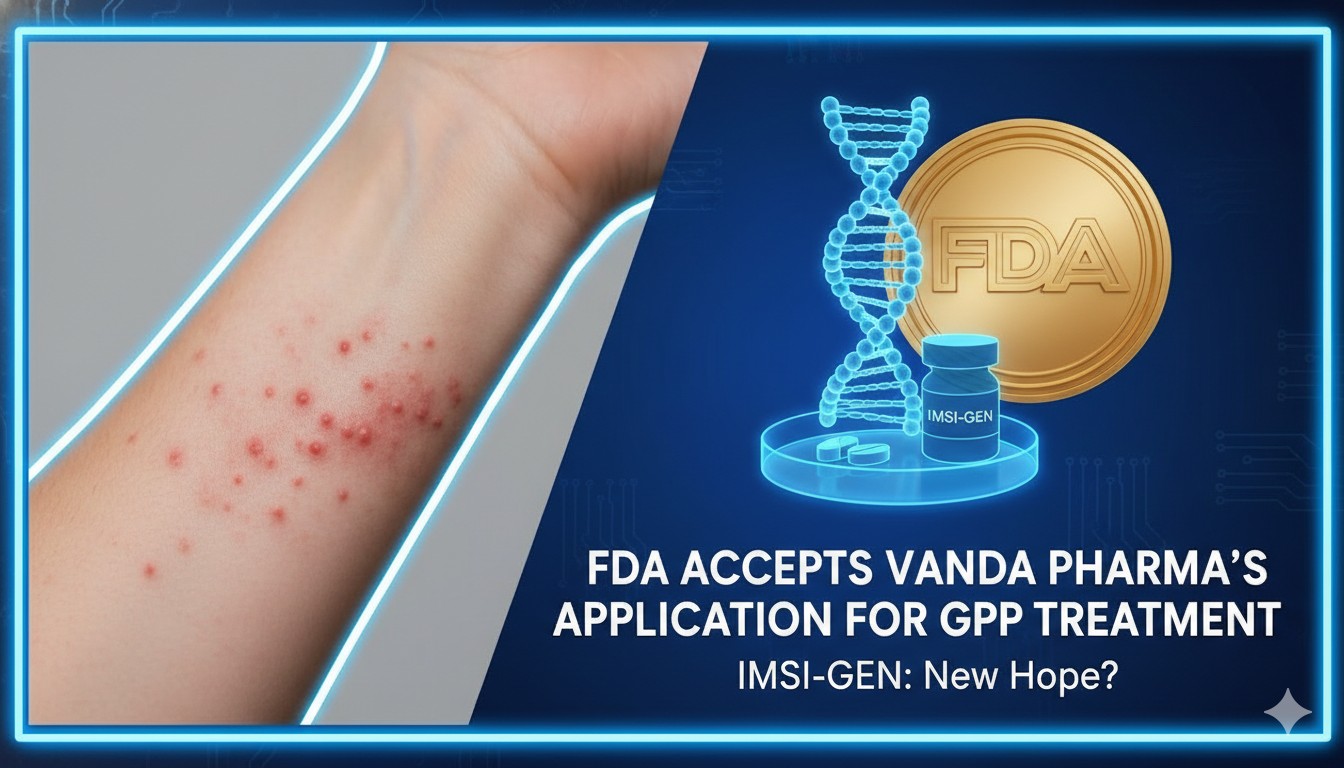
Vanda Pharmaceuticals has received FDA acceptance for its Biologics License Application (BLA) seeking approval of imsidolimab as a treatment for generalized pustular psoriasis (GPP), a rare and severe autoinflammatory skin condition. The FDA has set a target action date of December 12, 2026. This milestone follows positive results from the pivotal GEMINI-1 and GEMINI-2 Phase 3 trials, where a single intravenous dose of imsidolimab led to rapid disease clearance in a majority of patients, with sustained responses observed in maintenance dosing. The development highlights progress in addressing unmet needs in rare dermatological diseases, potentially offering patients a novel IL-36R antagonist therapy. Shares of Vanda Pharmaceuticals rose significantly on the announcement.
FDA Acceptance Marks Key Step Forward for Imsidolimab in Rare Skin Disorder
The U.S. Food and Drug Administration has formally accepted Vanda Pharmaceuticals’ Biologics License Application for imsidolimab, an investigational monoclonal antibody targeting the interleukin-36 receptor (IL-36R), for the treatment of generalized pustular psoriasis. This acceptance initiates the formal review process, with the agency assigning a Prescription Drug User Fee Act (PDUFA) target action date of December 12, 2026.
Generalized pustular psoriasis represents one of the most severe forms of psoriasis, characterized by widespread sterile pustules on erythematous skin, often accompanied by systemic symptoms such as fever, malaise, and potential life-threatening complications including sepsis or organ failure. Unlike plaque psoriasis, GPP flares can occur suddenly and unpredictably, frequently requiring hospitalization. Prevalence estimates for GPP vary globally but indicate a rare disease affecting between approximately 1.76 to 124 individuals per million in the general population, with higher rates reported in certain Asian populations due to genetic factors.
Many cases of GPP stem from genetic variants in the IL36RN gene, leading to loss-of-function mutations that result in uncontrolled IL-36 pathway activity. This overactivation drives the intense neutrophilic inflammation central to the disease. Imsidolimab, as an IL-36R antagonist, aims to block this pathway specifically, offering a targeted mechanism to interrupt the inflammatory cascade responsible for pustule formation, erythema, and scaling.
The BLA submission draws on robust data from the GEMINI program, which included two global Phase 3 studies: GEMINI-1 and GEMINI-2. In GEMINI-1, a multicenter, randomized, double-blind, placebo-controlled trial involving 45 adult patients with GPP, participants received a single intravenous infusion of either 750 mg imsidolimab, 300 mg imsidolimab, or placebo on Day 0. The primary endpoint focused on the proportion of patients achieving a Generalized Pustular Psoriasis Physician Global Assessment (GPPGA) score of 0 (clear) or 1 (almost clear) by Week 4.
Results showed that 53% of patients in the 750 mg imsidolimab group reached GPPGA 0/1 at Week 4, compared to only 13% in the placebo arm—a statistically significant difference. The 300 mg dose achieved a similar 53% response rate. This rapid onset of action is particularly noteworthy in GPP, where patients often endure acute, debilitating flares that demand swift intervention.
GEMINI-2 built on these findings by evaluating maintenance therapy. Sixteen patients who responded in GEMINI-1 (achieving GPPGA 0/1) were re-randomized to receive either monthly subcutaneous injections of 200 mg imsidolimab or placebo, with follow-up extending up to 92 weeks. Among those on active maintenance, 100% sustained GPPGA 0/1 through at least Week 24, and none experienced a disease flare. In contrast, only 25% of the placebo group maintained clearance, while 63% flared during the same period.
Safety data from both trials indicated a favorable profile. No treatment-related serious adverse events or discontinuations due to adverse events occurred in imsidolimab-treated patients. The absence of clinically meaningful safety signals supports the potential for imsidolimab to provide both acute relief during flares and longer-term control with subcutaneous maintenance.
If approved, imsidolimab would represent a significant advancement for GPP management, where current options often rely on off-label use of systemic agents such as retinoids, cyclosporine, methotrexate, or biologics not specifically approved for this indication. The single-dose intravenous induction followed by monthly subcutaneous maintenance could offer a convenient regimen for a disease that demands both immediate and sustained control.
This regulatory milestone aligns with Vanda’s broader strategy in rare and inflammatory diseases. The company has recently expanded its portfolio, with recent approvals in other specialty areas adding to its momentum. Market reaction to the BLA acceptance was positive, with Vanda’s stock (NASDAQ: VNDA) experiencing notable gains in premarket and intraday trading on the announcement day, reflecting investor optimism about the potential commercial impact of a first-in-class therapy for this underserved condition.
The review process now underway will evaluate the full dossier, including manufacturing, non-clinical, and additional clinical data. A decision by late 2026 could position imsidolimab as a new therapeutic option for U.S. patients facing the profound challenges of GPP.
Disclaimer: This article is for informational purposes only and does not constitute investment advice, medical advice, or a recommendation to buy or sell any securities. Information presented is based on publicly available data and should not be relied upon as the sole basis for decisions. Consult qualified professionals for personalized guidance.